>
Dactylopteriformes (Flying gurnards) >
Pegasidae (Seamoths)
Etymology: Pegasus: Named after the winged horse sprung from the blood of Medusa (Ref. 1418); volitans: From the Latin word 'volitans' meaning to fly.
More on author: Linnaeus.
Περιβάλλον: περιβάλλον / κλιματική ζώνη / εύρος βάθους / εύρος διανομής
Οικολογία
Θαλασσινό(ά); Υφάλμυρο βενθικό(ς); εύρος βάθους 1 - 73 m (Ref. 11441), usually 9 - 27 m (Ref. 1418). Tropical; 36°N - 37°S
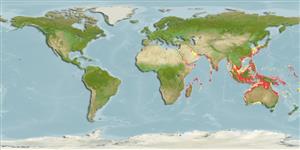
Indo-West Pacific: Delagoa Bay, Mozambique to Saudi Arabia (Persian Gulf) and throughout Gulf of Manaar to Bay of Bengal; along the east coast of Myanmar; north to Japan, south to tropical Australia (Ref. 1418) and Papua New Guinea (Ref. 6192).
Μέγεθος / Βάρος / Ηλικία
Γεννητική Ωρίμανση: Lm ? range ? - ? cm
Max length : 20.0 cm TL αρσενικό/απροσδιόριστο; (Ref. 90102)
Σύντομη περιγραφή
Κλείδες προσδιορισμού | Μορφολογία | Μορφομετρία
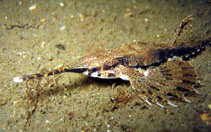
Ραχιαίες άκανθες (συνολικά) : 0; Μαλακές ραχιαίες ακτίνες (συνολικά) : 5; Εδρικές άκανθες: 0; Μαλακές εδρικές ακτίνες: 5; Σπόνδυλοι: 21. Body light brown or olive to dark brown-black dorsally and laterally, lighter ventrally. Tubercles absent on surface of carapace; no scales on orbit; distal margin of dorsal and anal fins perpendicular to horizontal axis of body. 4 pairs of dorsolateral body plates; 5 pairs of ventrolateral body plates; tail rings 12, anteriormost 9 mobile, last 3 fused; a lateral pair of posteriorly directed spines on terminal tail rings; suborbital shelf convex obscuring eye from ventral view; deep pits absent. Rostrum monomorphic and spatulate.
Body shape (shape guide): other; Cross section: flattened.
A rare species (Ref. 4264) collected from muddy and sandy bottoms of estuaries and bays. Known to 'walk' over the bottom using its tentacular pelvic fins. Juveniles expatriate to tropical regions; adults mainly found in muddy estuaries where they pair. Sometimes they are seen partly buried but also feed during the day. Sometimes found floating on the surface (Ref. 48635). Sometimes occurs in seagrass areas (Ref 90102). Feeds on small benthic organisms (Ref. 68964).
Κύκλος ζωής και συμπεριφορά ζευγαρώματος
Γεννητική Ωρίμανση | Αναπαραγωγή | Γεννοβολία | Αβγά | Γονιμότητα | Προνύμφες
Palsson, W.A. and T.W. Pietsch, 1989. Revision of the Acanthopterygian fish Family Pegasidae (Order Gasterosteiformes). Indo-Pac. Fish. (18):38 p. (Ref. 1418)
Κατάσταση Κόκκινου Καταλόγου IUCN (Ref. 130435: Version 2025-2 (Global))
Απειλή για τον άνθρωπο
Harmless
Ανθρώπινες χρήσεις
αλιεία: Εμπορικό(ά)
Εργαλεία
Ειδικές εκθέσεις
Λήψη XML
Διαδικτυακές πηγές
Εκτιμήσεις βάσει μοντέλων
Προτιμώμενη θερμοκρασία (Αναφ.
123201): 23.8 - 29.1, mean 28.1 °C (based on 1202 cells).
Δείκτης φυλογενετικής ποικιλότητας (Αναφ.
82804): PD
50 = 0.5391 [Uniqueness, from 0.5 = low to 2.0 = high].
Bayesian length-weight: a=0.01000 (0.00244 - 0.04107), b=3.04 (2.81 - 3.27), in cm total length, based on all LWR estimates for this body shape (Ref.
93245).
Τροφικό Επίπεδο (Αναφ.
69278): 3.5 ±0.37 se; based on food items.
Ευπάθεια στην αλιεία (Ref.
59153): Low vulnerability (10 of 100).
🛈