>
Dactylopteriformes (Flying gurnards) >
Pegasidae (Seamoths)
Etymology: Pegasus: Named after the winged horse sprung from the blood of Medusa (Ref. 1418); lancifer: From the Latin word 'lancea' meaning a light spear or lance.
More on author: Kaup.
Environnement : milieu / zone climatique / profondeur / gamme de distribution
Écologie
marin; saumâtre démersal; profondeur 20 - 50 m (Ref. 75154). Temperate; 33°S - 45°S
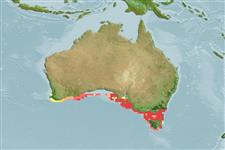
Eastern Indian Ocean: endemic to the temperate waters of southern Australia and Tasmania.
Taille / Poids / Âge
Maturité: Lm ? range ? - ? cm
Max length : 9.1 cm SL mâle / non sexé; (Ref. 1418)
Description synthétique
Clés d'identification | Morphologie | Morphométrie
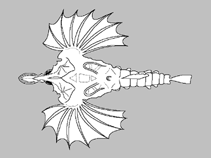
Épines dorsales (Total) : 0; Rayons mous dorsaux (Total) : 5; Épines anales: 0; Rayons mous anaux: 5; Vertèbres: 22. Body light to dark brown, olive or blue dorsally and laterally, light brown ventrally. Tail rings 14, anteriormost 7 mobile, remaining 7 fused; terminal tail rings with dorsal and ventral pairs of posteriorly directed spines; rostrum square in cross section; interpectoral plate absent. 4 pairs dorsolateral body plates; 5 pairs ventrolateral body plates; suborbital shelf convex, obscuring eye from ventral view; deep pits on dorsal surface of head and within interorbital depression absent. Orbit with small scales.
Body shape (shape guide): other; Cross section: flattened.
A benthic species found inshore of the continental shelf in muddy, silty and sandy bottoms, usually with seagrass; intertidal to 50 m depth (Ref. 75154). Large numbers of individuals are known to congregate in the shallows of estuaries. The species is capable of burying itself in the sediment and change colors to match the background.
Cycle de vie et comportement reproducteur
Maturité | Reproduction | Frai | Œufs | Fécondité | Larves
Spawning occurs as male & female swim from vent to vent, about 1 meter off the bottom, while they release eggs & sperms. The pair separates and each swims away as the eggs begin a pelagic phase.
Palsson, W.A. and T.W. Pietsch, 1989. Revision of the Acanthopterygian fish Family Pegasidae (Order Gasterosteiformes). Indo-Pac. Fish. (18):38 p. (Ref. 1418)
Statut dans la liste rouge de l'IUCN (Ref. 130435: Version 2025-2 (Global))
Menace pour l'homme
Harmless
Utilisations par l'homme
Pêcheries: d'intérêt potentiel
Outils
Articles particuliers
Télécharger en XML
Sources Internet
Estimations basées sur des modèles
Température préférée (Réf.
123201): 14.6 - 18, mean 16 °C (based on 31 cells).
Indice de diversité phylogénétique (Réf.
82804): PD
50 = 0.5391 [Uniqueness, from 0.5 = low to 2.0 = high].
Bayesian length-weight: a=0.01000 (0.00244 - 0.04107), b=3.04 (2.81 - 3.27), in cm total length, based on all LWR estimates for this body shape (Ref.
93245).
Niveau trophique (Réf.
69278): 3.3 ±0.4 se; based on size and trophs of closest relatives
Vulnérabilité de la pêche (Ref.
59153): Low vulnerability (10 of 100).
🛈