>
Syngnathiformes (Pipefishes and seahorses) >
Syngnathidae (Pipefishes and seahorses) > Syngnathinae
Etymology: Histiogamphelus: Greek, istion, istos = sail + Greek, gamphelai, -on = jawbone (Ref. 45335).
Eponymy: Dr Edward Alfred Briggs (1890–1969) was a zoologist at the Australian Museum (1912– 1918). [...] (Ref. 128868), visit book page.
Umwelt: Milieu / Klimazone / Tiefenbereich / Verbreitungsgebiet
Ökologie
seewasser; brackwasser riff-verbunden; tiefenbereich 3 - 20 m (Ref. 5316). Subtropical
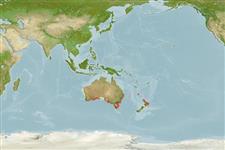
Eastern Indian Ocean: southern Australia, from South Australia to New South Wales and Tasmania.
Länge bei der ersten Reifung / Größe / Gewicht / Alter
Geschlechtsreife: Lm ?, range 12 - ? cm
Max length : 22.5 cm SL Männchen/unbestimmt; (Ref. 5316)
Kurzbeschreibung
Bestimmungsschlüssel | Morphologie | Morphometrie
Preferred habitat is uncertain. Some specimens have been dredged, others have been taken among loose seaweed and floating dead Zostera sp. Over fine sand bottom. Ovoviviparous (Ref. 205). The male carries the eggs in a brood pouch which is found under the tail (Ref. 205). Males may be brooding at 12.3 cm SL.
Lebenszyklus und Paarungsverhalten
Geschlechtsreife | Fortpflanzung | Ablaichen | Eier | Fruchtbarkeit | Larven
Male carries the eggs in a brood pouch (Ref. 205).
Dawson, C.E., 1985. Indo-Pacific pipefishes (Red Sea to the Americas). The Gulf Coast Research Laboratory Ocean Springs, Mississippi, USA. (Ref. 5316)
IUCN Rote Liste Status (Ref. 130435: Version 2025-2 (Global))
Bedrohung für Menschen
Harmless
Nutzung durch Menschen
Tools
Zusatzinformationen
Download XML
Internet Quellen
Schätzungen auf der Grundlage von Modellen
Bevorzugte Temperatur (Ref.
123201): 15.1 - 23.3, mean 17.8 °C (based on 264 cells).
Phylogenetischer Diversitätsindex (Ref.
82804): PD
50 = 0.7500 [Uniqueness, from 0.5 = low to 2.0 = high].
Bayesian length-weight: a=0.00035 (0.00015 - 0.00079), b=3.19 (3.00 - 3.38), in cm total length, based on LWR estimates for this (Sub)family-body shape (Ref.
93245).
Trophische Ebene (Ref.
69278): 3.4 ±0.5 se; based on size and trophs of closest relatives
Widerstandsfähigkeit (Ref.
120179): hoch, Verdopplung der Population dauert weniger als 15 Monate. (Preliminary K or Fecundity.).
Anfälligkeit der Fischerei (Ref.
59153): Low vulnerability (17 of 100).
🛈
Nährstoffe (Ref.
124155): Calcium = 55.1 [24.8, 145.3] mg/100g; Iron = 0.717 [0.373, 1.279] mg/100g; Protein = 19 [18, 20] %; Omega3 = 0.175 [0.094, 0.320] g/100g; Selenium = 13 [6, 30] μg/100g; VitaminA = 46.6 [14.0, 165.7] μg/100g; Zinc = 1.16 [0.72, 1.81] mg/100g (wet weight);