>
Acanthuriformes (Surgeonfishes) >
Siganidae (Rabbitfishes)
Etymology: Siganus: Latin, siganus = a fish, rabbit fish; by the similarity of the nose (Ref. 45335).
Environnement : milieu / zone climatique / profondeur / gamme de distribution
Écologie
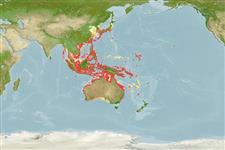
marin; saumâtre récifal; océanodrome (Ref. 51243); profondeur 1 - 50 m (Ref. 9813). Tropical; 42°N - 37°S, 90°E - 171°E
Western Pacific: southern Korea, southern Japan, Ogasawara Islands, Taiwan, southern China, Malaysia, Singapore, Thailand, Andaman Islands, Indonesia, Philippines, Yap, Palau, Pohnpei (Caroline Islands), Solomon Islands, Papua New Guinea, Vanuatu, New Caledonia, and Australia. Often misidentified as Siganus canaliculatus (Ref. 2334).
Longueur à la première maturité / Taille / Poids / Âge
Maturité: Lm 12.9 range ? - ? cm
Max length : 40.0 cm TL mâle / non sexé; (Ref. 9813); common length : 25.0 cm TL mâle / non sexé; (Ref. 9813); poids max. publié: 1.2 kg (Ref. 131261)
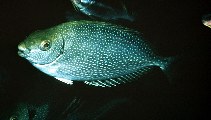
Épines dorsales (Total) : 13; Rayons mous dorsaux (Total) : 10; Épines anales: 7; Rayons mous anaux: 9; Vertèbres: 13. Body olive green or brown above, silvery below; fish frequently with a dark patch below origin of lateral line. Adults become mottled when frightened. Slender, pungent, venomous spines. Preopercular angle 89°-95°. Lower half to 2/3 of cheeks commonly covered with weak, scattered scales. Midline of thorax between pelvic ridges. Differs from S. argenteus in details of coloration and less deeply forked tail (Ref. 37816).
Body shape (shape guide): short and / or deep; Cross section: compressed.
Inhabits algal and seagrass flats and shallow lagoon and coastal reefs (Ref. 9710, 11230). Forms schools. Mainly diurnal. Juveniles feed on filamentous algae, adults feed on leafy algae and seagrasses (Ref. 9710). Commercially cultured in Japan. Commonly found in large estuaries (Ref. 9002). Anterolateral glandular groove with venom gland (Ref. 57406).
In Belau, ripe individuals form prespawning congregations of 30-60 individuals in shoal areas of inner reef flats; spawning occurs on the 4th or 5th day of the new moon; spawning sites are near reef edge. About 300,000 eggs/female at a single spawning. Individuals that spawn in consecutive yrs. & that 2+ yr. class fish could spawn more than once in a single season. Aug (Ref 1754) in Belau.
Woodland, D.J., 1990. Revision of the fish family Siganidae with descriptions of two new species and comments on distribution and biology. Indo-Pac. Fish. (19):136 p. (Ref. 1419)
Statut dans la liste rouge de l'IUCN (Ref. 130435: Version 2025-2 (Global))
Utilisations par l'homme
Pêcheries: commercial; Aquaculture: commercial; pêche sportive: oui
Outils
Articles particuliers
Télécharger en XML
Sources Internet
Estimations basées sur des modèles
Température préférée (Réf.
123201): 22.6 - 29, mean 27.9 °C (based on 760 cells).
Indice de diversité phylogénétique (Réf.
82804): PD
50 = 0.5000 [Uniqueness, from 0.5 = low to 2.0 = high].
Bayesian length-weight: a=0.01288 (0.01005 - 0.01651), b=3.04 (2.99 - 3.09), in cm total length, based on LWR estimates for this species (Ref.
93245).
Niveau trophique (Réf.
69278): 2.0 ±0.1 se; based on diet studies.
Generation time: 1.3 ( na - na) years. Estimated as median ln(3)/K based on 1
growth studies.
Résilience (Réf.
120179): Haut, temps minimum de doublement de population inférieur à 15 mois (Preliminary K or Fecundity.).
Vulnérabilité de la pêche (Ref.
59153): Low vulnerability (21 of 100).
🛈
Nutriments (Ref.
124155): Calcium = 36.7 [18.1, 83.9] mg/100g; Iron = 0.709 [0.352, 1.481] mg/100g; Protein = 19.2 [17.9, 20.4] %; Omega3 = 0.145 [0.082, 0.262] g/100g; Selenium = 24.8 [10.9, 52.7] μg/100g; VitaminA = 34.4 [9.7, 114.8] μg/100g; Zinc = 1.8 [0.7, 3.5] mg/100g (wet weight); based on
nutrient studies.