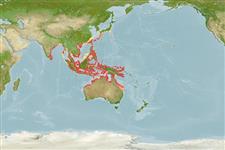
Ambiente: milieu / zona climatica / distribuzione batimetrica / gamma di distribuzione
Ecologia
marino; salmastro associati a barriera corallina; distribuzione batimetrica 1 - ? m (Ref. 48637), usually 1 - 20 m (Ref. 27115). Tropical; 23°C - 28°C (Ref. 27115); 35°N - 25°S, 77°E - 154°E
Indo-West Pacific: southern India, Sri Lanka, Andaman Islands, Thailand, southern and eastern coasts of China, Taiwan, Ryukyu, Philippines, Malaysia, Singapore, Indonesia and Northern Territory in Australia.
Dimensione / Peso / Età
Maturità: Lm ? range ? - ? cm
Max length : 30.0 cm TL maschio/sesso non determinato; (Ref. 9710); common length : 20.0 cm TL maschio/sesso non determinato; (Ref. 9813)
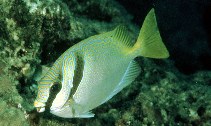
Spine dorsali (totale) : 13; Raggi dorsali molli (totale) : 10; Spine anali: 7; Raggi anali molli: 9; Vertebre: 13. A brown band running diagonally from nape to chin; another from 4th-5th dorsal spine base to pectoral fin base; ocular and shoulder bands spotted with blue; a zone of silvery yellow posterior and adjacent to the shoulder band. Preopercular angle 100°-111°; cheek scalation variable from few to almost fully scaled; midline of thorax fully scaled, sometimes with a row missing from pelvic ridges. A prominent rim or short tube encircle the anterior nostril, with a little peak on it posteriorly. Spines stout, fairly pungent and venomous.
Body shape (shape guide): short and / or deep; Cross section: compressed.
Inhabits shallow coastal waters, around hard coral reefs and areas of sand with patches of rock and soft coral. Tolerant of murky waters. Larger juveniles and adults occur in pairs in coastal reef flats, slopes and estuaries . Small juveniles are found in mangroves and enter freshwater, moving to reefs usually in small groups among corals (Ref. 48637). Feed on benthic seaweeds (Ref. 9813).
Ciclo vitale e comportamento di accoppiamento
Maturità | Riproduzione | Deposizione | Uova | Fecondità | Larve
Woodland, D.J., 1990. Revision of the fish family Siganidae with descriptions of two new species and comments on distribution and biology. Indo-Pac. Fish. (19):136 p. (Ref. 1419)
Stato della Lista Rossa IUCN (Ref. 130435: Version 2025-2 (Global))
Usi umani
Pesca: scarso interesse commerciale; Acquario: Commerciale
Strumenti
Rapporti speciali
Scarica XML
Fonti Internet
Stime basate su modelli
Temperatura preferita (Fonte Biblio.
123201): 25.4 - 29.1, mean 28.3 °C (based on 1192 cells).
Indice di diversità filogenetica (Fonte Biblio.
82804): PD
50 = 0.5000 [Uniqueness, from 0.5 = low to 2.0 = high].
Bayesian length-weight: a=0.01950 (0.01055 - 0.03602), b=3.11 (2.95 - 3.27), in cm total length, based on LWR estimates for this species & Genus-body shape (Ref.
93245).
Livello trofico (Fonte Biblio.
69278): 2.7 ±0.31 se; based on food items.
Resilienza (Fonte Biblio.
120179): Alto, tempo minimo di raddoppiamento della popolazione meno di 15 mesi (Preliminary K or Fecundity.).
Vulnerabilità della pesca (Ref.
59153): Low vulnerability (20 of 100).
🛈
Nutrienti (Ref.
124155): Calcium = 38.5 [18.8, 90.0] mg/100g; Iron = 0.671 [0.313, 1.534] mg/100g; Protein = 19 [18, 20] %; Omega3 = 0.121 [0.063, 0.240] g/100g; Selenium = 20.3 [7.8, 50.6] μg/100g; VitaminA = 33 [9, 121] μg/100g; Zinc = 1.42 [0.56, 3.07] mg/100g (wet weight);