>
Syngnathiformes (Pipefishes and seahorses) >
Syngnathidae (Pipefishes and seahorses) > Syngnathinae
Etymology: Hippocampus: Greek, ippos = horse + Greek,kampe = curvature (Ref. 45335).
Miljö: miljö / Klimatzon / djupintervall / distributionsområde
Ekologi
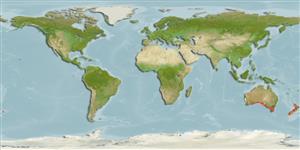
marina; brackvatten bottenlevande; ej vandrande; djupintervall 0 - 104 m (Ref. 52034). Temperate; 24°S - 50°S, 80°E - 120°W (Ref. 52034)
Southwest Pacific: Australia and New Zealand (Ref. 115213). Occurrence in Thailand and the Philippines (Ref. 43081) needs verification.
Längd vid första mognad / Storlek / Vikt / Ålder
Könsmognad: Lm 8.7 range ? - ? cm
Max length : 35.0 cm OT hane/ej könsbestämd; (Ref. 6787); common length : 18.0 cm OT hane/ej könsbestämd; (Ref. 9003)
Kort beskrivning
Bestämningsnycklar | Morfologi | Morfometri
Taggstrålar i ryggfenan (totalt) : 0; Mjukstrålar i ryggfenan (totalt) : 25 - 31; Taggstrålar i analfenan: 0; Mjukstrålar i analfenan: 4.
Body shape (shape guide): other; Cross section: angular.
Found in large rock pools at low tide. They remain motionless amidst seaweed. Juveniles are pelagic (Ref. 30915) or attached to drifting seaweeds (Ref. 31838). Feed on minute crustaceans (e.g. copepods and amphipods). Nocturnal (Ref. 9003). Ovoviviparous (Ref. 205). The male carries the eggs in a brood pouch which is found under the tail (Ref. 205). Seen in groups at night. Also around jetties and other man-made objects; attached to sponges and colonial hydroids in deeper water (Ref. 30915). Length measurements refer to height (= TL - head length).
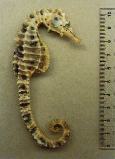
This is the largest seahorse species in southeastern Australia, and has more dorsal fin rays and tail rings than any other seahorse (Ref. 31838). Sold locally and internationally for the aquarium trade (Ref. 31838). Dried and sold to the Oriental medicine trade as a tonic and aphrodisiac (Ref. 5316, 34026).
Several subsequent broods are carried by the male in a brood pouch during the spawning season. Do not obviously pair, as other seahorses do (Ref. 30915). Fertilised eggs deposited by females in the pouch of males are incubated for about four weeks before hatching (Ref. 31838). Hatching occurs at night, coinciding with full moon periods during summer months (Ref. 31838). Young emerge from the pouch and immediately rise to the surface where they grasp floating debris with their tail (Ref. 31838).
Lourie, S.A., R.A. Pollom and S.J. Foster, 2016. A global revision of the seahorses Hippocampus Rafinesque 1810 (Actinopterygii: Syngnathiformes): taxonomy and biogeography with recommendations for further research. Zootaxa 4146(1):1-66. (Ref. 115213)
Status på IUCN:s rödlista (Ref. 130435: Version 2025-2 (Global))
Hot mot människor
Harmless
Mänskliga användningsområden
Fiskeri: saknar intresse; Akvarium: Kommersiell
Verktyg
Särskilda rapporter
Ladda ner XML
Internet-källor
Uppskattningar baserade på modeller
Önskad temperatur (Ref.
123201): 14.1 - 19.8, mean 17 °C (based on 322 cells).
Index för fylogenetisk mångfald (Ref.
82804): PD
50 = 0.5000 [Uniqueness, from 0.5 = low to 2.0 = high].
Bayesian length-weight: a=0.00447 (0.00176 - 0.01132), b=3.00 (2.78 - 3.22), in cm total length, based on LWR estimates for this (Sub)family-body shape (Ref.
93245).
Trofisk nivå (Ref.
69278): 3.4 ±0.0 se; based on diet studies.
Resiliens (Ref.
120179): Hög, lägsta populationsfördubblingstid mindre än 15 månader (tm=1; Assuming annual Fec<1000).
Sårbarhet i fisket (Ref.
59153): Low vulnerability (10 of 100).
🛈
Näringsämnen (Ref.
124155): Calcium = 61.4 [38.8, 114.6] mg/100g; Iron = 0.447 [0.279, 0.744] mg/100g; Protein = 17.8 [16.8, 18.9] %; Omega3 = 0.543 [0.315, 0.933] g/100g; Selenium = 15.8 [7.9, 37.3] μg/100g; VitaminA = 9.31 [3.19, 26.90] μg/100g; Zinc = 0.702 [0.518, 0.958] mg/100g (wet weight);