>
Blenniiformes (Blennies) >
Tripterygiidae (Triplefin blennies) > Tripterygiinae
Etymology: Notoclinops: Greek, noton = back + Greek, klinein, kline = sloping and also bed, due to the four apophyses of sphenoid bone + Greek, ops = appearance (Ref. 45335).
Umwelt: Milieu / Klimazone / Tiefenbereich / Verbreitungsgebiet
Ökologie
seewasser demersal; tiefenbereich 0 - 40 m (Ref. 9003). Temperate
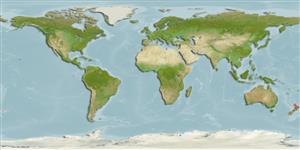
Southwest Pacific: New Zealand.
Größe / Gewicht / Alter
Geschlechtsreife: Lm ? range ? - ? cm
Max length : 3.6 cm SL Männchen/unbestimmt; (Ref. 13227)
Kurzbeschreibung
Bestimmungsschlüssel | Morphologie | Morphometrie
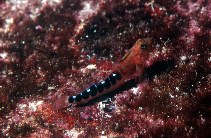
Rückenflossenstacheln (insgesamt) : 21 - 23; Rückenflossenweichstrahlen (insgesamt) : 10 - 13; Afterflossenstacheln: 1; Afterflossenweichstrahlen: 23 - 25. Head mauve with bright orange patches. Eyes with a fine bright blue line around pupils. Body with 9-10 orange to blackish dorsal bands on the posterior half. Distinguished from other triplefins by the distinctive color pattern. Pelvic fins reduced to 2 rays.
Adults occur in tidal pools and the subtidal zone, usually on encrusted walls and other overhangs. They remove parasites from large fishes such as moray eels (Ref. 13227). Eggs are hemispherical and covered with numerous sticky threads that anchor them in the algae on the nesting sites (Ref. 240). Larvae are planktonic which occur primarily in shallow, nearshore waters (Ref. 94114).
Lebenszyklus und Paarungsverhalten
Geschlechtsreife | Fortpflanzung | Ablaichen | Eier | Fruchtbarkeit | Larven
Fricke, R., 1994. Tripterygiid fishes of Australia, New Zealand and the southwest Pacific Ocean (Teleostei). Theses Zool. 24:1-585. (Ref. 13227)
IUCN Rote Liste Status (Ref. 130435: Version 2025-2 (Global))
Bedrohung für Menschen
Harmless
Nutzung durch Menschen
Tools
Zusatzinformationen
Download XML
Internet Quellen
Schätzungen auf der Grundlage von Modellen
Bevorzugte Temperatur (Ref.
123201): 13.6 - 22.3, mean 18.2 °C (based on 30 cells).
Phylogenetischer Diversitätsindex (Ref.
82804): PD
50 = 0.6250 [Uniqueness, from 0.5 = low to 2.0 = high].
Bayesian length-weight: a=0.00617 (0.00290 - 0.01310), b=3.04 (2.86 - 3.22), in cm total length, based on LWR estimates for this (Sub)family-body shape (Ref.
93245).
Trophische Ebene (Ref.
69278): 3.1 ±0.3 se; based on size and trophs of closest relatives
Widerstandsfähigkeit (Ref.
120179): hoch, Verdopplung der Population dauert weniger als 15 Monate. (Preliminary K or Fecundity.).
Anfälligkeit der Fischerei (Ref.
59153): Low vulnerability (10 of 100).
🛈
Nährstoffe (Ref.
124155): Calcium = 387 [170, 1,915] mg/100g; Iron = 1.47 [0.57, 3.79] mg/100g; Protein = 17.6 [15.8, 19.3] %; Omega3 = 0.459 [0.109, 1.913] g/100g; Selenium = 24.1 [4.7, 100.8] μg/100g; VitaminA = 8.22 [0.95, 66.24] μg/100g; Zinc = 2.61 [1.19, 5.15] mg/100g (wet weight);