>
Scombriformes (Mackerels) >
Chiasmodontidae (Snaketooth fishes)
Etymology: Pseudoscopelus: Greek, pseudes = false + Greek, skopelos = a lantern fish (Ref. 45335). Lütken did not recognize the presence of photophores on the body, confusing them with pores, but referred to a genus of lanternfish (Scopelus now Myctophum) when he named the genus (Ref. 85782).
More on author: Lütken.
Environnement : milieu / zone climatique / profondeur / gamme de distribution
Écologie
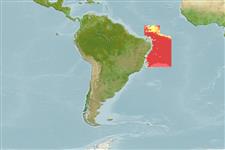
marin bathypélagique; profondeur 250 - 1370 m (Ref. 85782). Deep-water; 69°N - 20°S, 39°W - 23°W (Ref. 85782)
Western Atlantic, United States to Brazil, continental shelf and Islands of the Caribbean in the west to Central Atlantic. A tentative identification of a juvenile from off Nigeria (5º56’ N, 4º03’ E) extends the species range to the Eastern Atlantic.
Taille / Poids / Âge
Maturité: Lm ? range ? - ? cm
Max length : 15.5 cm SL mâle / non sexé; (Ref. 13608)
Description synthétique
Clés d'identification | Morphologie | Morphométrie
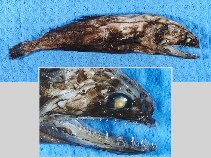
Épines dorsales (Total) : 7 - 9; Rayons mous dorsaux (Total) : 19 - 22; Rayons mous anaux: 19 - 22; Vertèbres: 35 - 36. This species can be distinguished from other members of the Pseudoscopelus scriptus species group by a single character, anal-fin photophores (saf) not extending anterior to the level of anus (vs. extending anteriorly to level of or beyond anus). It is further distinguished from the other species by a set of characteristics: mesial series of premaxillary teeth in 3-4 rows (vs. single row in P. obtusifrons and P. pierbartus); mesial series of teeth in rows of 3-4 teeth gradually increasing of size from lateral to mesial (vs. in rows of 2-3 teeth, with internal row much larger than other teeth in P. cordilluminatus); total vertebrae 35-36, precaudal 18-19 (vs. 31, 14 in P. cephalus);pigmentation in the internal part of mouth exclusive to a dusky area in the skin covering regions with teeth on premaxilla and dentary (vs. internal area of mouth and gill arches black in P. sagamianus ) (Ref. 85782).
Body shape (shape guide): elongated.
A meso- to bathypelagic species found at 250-1,370 m (mean 786 m); juveniles to about 30.0 mm are known from 95 to 590 m (Ref. 85782).
Cycle de vie et comportement reproducteur
Maturité | Reproduction | Frai | Œufs | Fécondité | Larves
Melo, M.R.S., 2010. A revision of the genus Pseudoscopelus Lütken (Chiasmodontidae: Acanthomorphata) with descriptions of three new species. Zootaxa 2710:1-78. (Ref. 85782)
Statut dans la liste rouge de l'IUCN (Ref. 130435: Version 2025-2 (Global))
Menace pour l'homme
Harmless
Utilisations par l'homme
Outils
Articles particuliers
Télécharger en XML
Sources Internet
Estimations basées sur des modèles
Température préférée (Réf.
123201): 4.1 - 11.4, mean 9.9 °C (based on 8 cells).
Indice de diversité phylogénétique (Réf.
82804): PD
50 = 0.5000 [Uniqueness, from 0.5 = low to 2.0 = high].
Bayesian length-weight: a=0.00389 (0.00180 - 0.00842), b=3.12 (2.94 - 3.30), in cm total length, based on all LWR estimates for this body shape (Ref.
93245).
Niveau trophique (Réf.
69278): 3.7 ±0.2 se; based on size and trophs of closest relatives
Résilience (Réf.
120179): Milieu, temps minimum de doublement de population : 1,4 à 4,4 années (Assuming tmax>3).
Vulnérabilité de la pêche (Ref.
59153): Low vulnerability (10 of 100).
🛈