>
Mulliformes (Goatfishes) >
Mullidae (Goatfishes)
Etymology: Parupeneus: Latin, parum, parvum = small + Peneus, the name of a river.
More on authors: Randall & Guézé.
Umwelt: Milieu / Klimazone / Tiefenbereich / Verbreitungsgebiet
Ökologie
seewasser riff-verbunden; tiefenbereich 1 - 55 m (Ref. 54393). Tropical
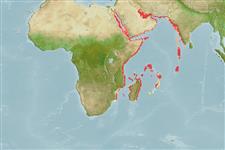
Western Indian Ocean: Persian Gulf and the Gulf of Oman to western Pakistan.
Größe / Gewicht / Alter
Geschlechtsreife: Lm ? range ? - ? cm
Max length : 23.0 cm TL Männchen/unbestimmt; (Ref. 11441)
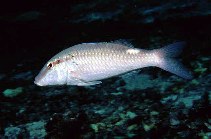
Rückenflossenstacheln (insgesamt) : 8; Rückenflossenweichstrahlen (insgesamt) : 9; Afterflossenstacheln: 1; Afterflossenweichstrahlen: 7; Wirbelzahl: 24. Diagnosis: Pectoral rays 15-17 (usually 16). Gill rakers 6-8 + 22-25 (total 29-33). Body moderately elongate, the depth 3.5-4.05 in SL (to 4.35 in juveniles); head length (HL) 2.75-3.0 in SL; snout length 1.75-2.3 in head length; upper-jaw length 3.0-3.5 in HL; barbels relatively short, 1.4-1.65 in HL; third dorsal spine longest, 1.65-1.95 in HL; last dorsal soft ray only slightly longer than penultimate ray; pectoral-fin length 1.5-1.7 in HL; pelvic-fin length 1.5-1.8 in HL. Gray to brownish red dorsally, whitish to light red ventrally, with a small pearly white to pale blue spot on each scale of body below the lateral line (center of scales on body above lateral line whitish but not as a distinct spot); an elongate white spot anteriorly on upper side of caudal peduncle, sometimes followed by a dusky spot of about the same size; a brown band on snout from upper lip to eye, often continuing onto postorbital head and narrowly a short distance onto body (band usually not persisting in preservative) (Ref. 54393).
Body shape (shape guide): fusiform / normal; Cross section: compressed.
Occurs on open sand or silty sand bottom or on sand and rubble in the vicinity of reefs or rocky outcrops (Ref. 54393).
Lebenszyklus und Paarungsverhalten
Geschlechtsreife | Fortpflanzung | Ablaichen | Eier | Fruchtbarkeit | Larven
Randall, J.E., 2004. Revision of the goatfish genus Parupeneus (Perciformes: Mullidae), with descriptions of two new species. Indo-Pac. Fish. (36):64 p. (Ref. 54393)
IUCN Rote Liste Status (Ref. 130435: Version 2025-2 (Global))
Bedrohung für Menschen
Harmless
Nutzung durch Menschen
Fischereien: bycatch
Tools
Zusatzinformationen
Download XML
Internet Quellen
Schätzungen auf der Grundlage von Modellen
Bevorzugte Temperatur (Ref.
123201): 25.5 - 29.3, mean 27.3 °C (based on 238 cells).
Phylogenetischer Diversitätsindex (Ref.
82804): PD
50 = 0.5000 [Uniqueness, from 0.5 = low to 2.0 = high].
Bayesian length-weight: a=0.01175 (0.00543 - 0.02542), b=3.09 (2.92 - 3.26), in cm total length, based on LWR estimates for this Genus-body shape (Ref.
93245).
Trophische Ebene (Ref.
69278): 3.4 ±0.4 se; based on size and trophs of closest relatives
Widerstandsfähigkeit (Ref.
120179): hoch, Verdopplung der Population dauert weniger als 15 Monate. (Preliminary K or Fecundity.).
Anfälligkeit der Fischerei (Ref.
59153): Low vulnerability (13 of 100).
🛈
Nährstoffe (Ref.
124155): Calcium = 45.6 [21.7, 105.3] mg/100g; Iron = 0.344 [0.174, 0.796] mg/100g; Protein = 17.9 [14.5, 20.9] %; Omega3 = 0.135 [0.075, 0.244] g/100g; Selenium = 48.2 [22.5, 116.8] μg/100g; VitaminA = 232 [45, 991] μg/100g; Zinc = 0.597 [0.348, 1.126] mg/100g (wet weight);