>
Cyprinodontiformes (Rivulines, killifishes and live bearers) >
Poeciliidae (Poeciliids) > Poeciliinae
Etymology: Brachyrhaphis: Greek, brachys, eia = short + Greek, raphis = needle (Ref. 45335).
Eponymy: Dr Leslie Rensselaer Holdridge (1907–1999) was an American botanist and ecologist with a particular interest in forests and forestry. [...] (Ref. 128868), visit book page.
Entorno: milieu / zona climática / rango de profundidad / gama de distribución
Ecología
; agua dulce pelágico; no migratorio. Tropical; 21°C - 37°C (Ref. 36880)
Central America: Río Prinzapolka, Nicaragua to the Río Pacuare, Costa Rica.
Tamaño / Peso / Edad
Madurez: Lm ? range ? - ? cm
Max length : 5.0 cm SL macho / no sexado; (Ref. 36880); 5.0 cm (female)
Descripción breve
Claves de identificación | Morfología | Morfometría
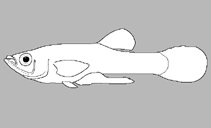
Anal fin almost as long as or longer than head length. Dorsal fin rays long and almost reach the base of the caudal fin, lacking a distance equal to or less than the eye diameter. Sides of the body with 10 - 12 dark bars and 3 or 4 series of spots which correspond to the longitudinal scale rows along the body. Dark caudal fin margin with a vertical series of short dark streaks a little closer to the base than to the posterior margin of the tail. Dorsal fin red-orange with black stripes on the base. Body gray with a tenuous pink or orange hue (Ref. 36880).
Body shape (shape guide): elongated; Cross section: oval.
Inhabits stagnant waters or creeks with low current velocity between 35 and 620 m elevation; in temperatures from 21 to 37°C; swims in small groups over muddy bottoms. Feeds on terrestrial insects (Ref. 36880).
Ciclo vital y comportamiento de apareamiento
Madurez | Reproducción | Puesta | Huevos | Fecundidad | Larva
Lucinda, P.H.F., 2003. Poeciliidae (Livebearers). p. 555-581. In R.E. Reis, S.O. Kullander and C.J. Ferraris, Jr. (eds.) Checklist of the Freshwater Fishes of South and Central America. Porto Alegre: EDIPUCRS, Brazil. (Ref. 50894)
Situación en la Lista Roja de la UICN (Ref. 130435: Version 2025-2 (Global))
Amenaza para el ser humano
Harmless
Usos humanos
Herramientas
Informes especiales
Descargar XML
Fuentes de Internet
Estimaciones basadas en modelos
Índice de diversidad filogenética (Referencia
82804): PD
50 = 0.5002 [Uniqueness, from 0.5 = low to 2.0 = high].
Bayesian length-weight: a=0.00851 (0.00369 - 0.01962), b=3.15 (2.96 - 3.34), in cm total length, based on LWR estimates for this (Sub)family-body shape (Ref.
93245).
Nivel trófico (Referencia
69278): 3.5 ±0.50 se; based on food items.
Resiliencia (Referencia
120179): Alto, población duplicada en un tiempo mínimo inferior a 15 meses (Preliminary K or Fecundity.).
Vulnerabilidad pesquera (Ref.
59153): Low vulnerability (10 of 100).
🛈