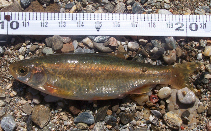
Klassifizierung / Names
Namen | Synonyme | Catalog of Fishes(Gattung, Arten) | ITIS | CoL | WoRMS | Cloffa
>
Cypriniformes (Carps) >
Leuciscidae (Minnows) > Leuciscinae
Etymology: Tropidophoxinellus: Greek, trope, -idos = turn + Greek, phoxinos = certain river fish; diminituve (Ref. 45335).
Umwelt: Milieu / Klimazone / Tiefenbereich / Verbreitungsgebiet
Ökologie
; süßwasser demersal. Subtropical; 38°N - 37°N, 22°E - 24°E
Europe: Nedas to Evrotas drainages in southern Peloponnese, Greece.
Größe / Gewicht / Alter
Geschlechtsreife: Lm ? range ? - ? cm
Max length : 9.5 cm SL Männchen/unbestimmt; (Ref. 59043); max. veröff. Alter: 4 Jahre (Ref. 59043)
Diagnosed from Tropidophoxinellus hellenicus by having the following characters: mouth terminal, upper jaw projecting slightly beyond lower jaw; and 40-44 + 2-3 scales along lateral line (Ref. 59043).
Body shape (shape guide): fusiform / normal.
Found in lowland water courses with little current (Ref. 26100). Also inhabits springs and stretches of streams with moderate current. Most populations occur in small streams and are very sensitive to water abstraction and pollution (Ref. 59043). Feeds on invertebrates, plants (Ref. 26100) and small aquatic insects (Ref. 59043). Threatened due to pollution, habitat destruction (Ref. 26100) and water abstraction (Ref. 59043).
Lebenszyklus und Paarungsverhalten
Geschlechtsreife | Fortpflanzung | Ablaichen | Eier | Fruchtbarkeit | Larven
Eggs adhesive, 1.6 mm in diameter (Ref. 59043).
Kottelat, M. and J. Freyhof, 2007. Handbook of European freshwater fishes. Publications Kottelat, Cornol and Freyhof, Berlin. 646 pp. (Ref. 59043)
IUCN Rote Liste Status (Ref. 130435: Version 2025-2 (Global))
Bedrohung für Menschen
Harmless
Nutzung durch Menschen
Fischereien: nicht kommerziell
Tools
Zusatzinformationen
Download XML
Internet Quellen
Schätzungen auf der Grundlage von Modellen
Phylogenetischer Diversitätsindex (Ref.
82804): PD
50 = 0.7500 [Uniqueness, from 0.5 = low to 2.0 = high].
Bayesian length-weight: a=0.00724 (0.00353 - 0.01485), b=3.14 (2.97 - 3.31), in cm total length, based on LWR estimates for this (Sub)family-body shape (Ref.
93245).
Trophische Ebene (Ref.
69278): 2.7 ±0.24 se; based on food items.
Widerstandsfähigkeit (Ref.
120179): mittel, Verdopplung der Population dauert 1,4 - 4,4 Jahre. (Assuming fecundity<10,000).
Anfälligkeit der Fischerei (Ref.
59153): Low vulnerability (10 of 100).
🛈