>
Perciformes/Uranoscopoidei (Sand dwellers) >
Pinguipedidae (Sandperches)
Etymology: Parapercis: Greek, para = the side of + Greek, perke = perch (Ref. 45335); colemani: Named in honor of Neville Coleman who first discovered this species in Norfolk I.
Eponymy: Neville Coleman (1938–2012) was an Australian award-winning environmental photographer, underwater explorer and conservationist with an interest and expertise in nudibranchs, sea grass, marine sponges, and various types of coral. [...] (Ref. 128868), visit book page.
More on authors: Randall & Francis.
Umwelt: Milieu / Klimazone / Tiefenbereich / Verbreitungsgebiet
Ökologie
seewasser demersal; tiefenbereich 2 - 113 m (Ref. 59349). Subtropical
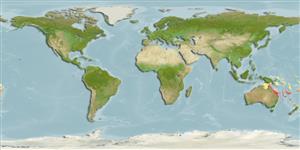
Pacific: Norfolk Island.
Größe / Gewicht / Alter
Geschlechtsreife: Lm ? range ? - ? cm
Max length : 8.2 cm SL Männchen/unbestimmt; (Ref. 26156)
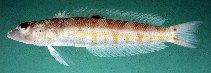
Rückenflossenstacheln (insgesamt) : 5; Rückenflossenweichstrahlen (insgesamt) : 21; Afterflossenstacheln: 1; Afterflossenweichstrahlen: 17. This species is distinguished by the following: D V,21; A I,17; pectoral rays 17-18; lateral-line scales 57-58; scales above lateral line 6; gill rakers 3 + 11; body depth 5.4 in SL; palatine teeth absent; canine teeth in outer row on each side at front of jaws 3; penultimate dorsal and anal rays are the longest; pelvic fins do not reach anus; lower half of caudal fin is slightly rounded, the upper half slightly emarginate with a short prolongation of the 2nd to 4th branched rays; last interspinous membrane of the dorsal fin attached to the first soft ray about 1/5 length of ray from its base, Colouration: upper third of body orangish brown, the pigment concentrated on the scale edges, with a longitudinal series of 8 small dusky orange-red spots on he upper side; lower 2/3 of body white with 10 vertical yellow bars on ventral half (hence a midlateral white stripe on body due to lack of pigmentation); small dark brown spots scattered on postorbital head; small orange-red spots 2 in vertical alignment at base of caudal fin (Ref. 26156).
Cross section: compressed.
A single specimen was collected at a depth of 1.5 m (Ref. 26156).
Lebenszyklus und Paarungsverhalten
Geschlechtsreife | Fortpflanzung | Ablaichen | Eier | Fruchtbarkeit | Larven
Randall, J.E. and M.P. Francis, 1993. Parapercis colemani, a new pinguipedid fish from Norfolk Island, south-western Pacfiic Ocean. N.Z. J. Mar. Freshwat. Res. 27(2):209-214. (Ref. 26156)
IUCN Rote Liste Status (Ref. 130435: Version 2025-2 (Global))
Bedrohung für Menschen
Harmless
Nutzung durch Menschen
Fischereien: kleinfischerei
Tools
Zusatzinformationen
Download XML
Internet Quellen
Schätzungen auf der Grundlage von Modellen
Bevorzugte Temperatur (Ref.
123201): 24.1 - 26.4, mean 25.5 °C (based on 72 cells).
Phylogenetischer Diversitätsindex (Ref.
82804): PD
50 = 0.5000 [Uniqueness, from 0.5 = low to 2.0 = high].
Bayesian length-weight: a=0.00692 (0.00314 - 0.01524), b=3.06 (2.88 - 3.24), in cm total length, based on LWR estimates for this Genus-body shape (Ref.
93245).
Trophische Ebene (Ref.
69278): 3.4 ±0.4 se; based on size and trophs of closest relatives
Widerstandsfähigkeit (Ref.
120179): hoch, Verdopplung der Population dauert weniger als 15 Monate. (Preliminary K or Fecundity.).
Anfälligkeit der Fischerei (Ref.
59153): Low vulnerability (10 of 100).
🛈