การจำแนกประเภท / ชื่อ
ชื่อสามัญ | ชื่อพ้อง | Catalog of Fishes(สกุล, ชนิด) | ITIS | CoL | WoRMS | Cloffa
>
Cichliformes (Cichlids, convict blennies) >
Cichlidae (Cichlids) > Cichlinae
Etymology: Aequidens: Latin, aequus, equal, equally + Latin, dens, dentis = teeth (Ref. 45335).
More on author: Heckel.
Taxonomic Remarks
Redescribed by Kullander & Ferreira (1990).
สิ่งแวดล้อม : สิ่งแวดล้อม / เขตภูมิอากาศ / ระดับความลึก / ระยะการกระจายสินค้า
นิเวศวิทยา
; น้ำจืด กลุ่มสัตว์หน้าดิน,กลุ่มสัตว์พื้นท้องน้ำ; pH range: 6.5 - 7.5; dH range: ? - 10. Tropical; 22°C - 30°C (Ref. 40602)
South America: Amazon River basin, in the middle and lower Negro River, Uatumã, Preto da Eva, and Puraquequara rivers.
ขนาด / น้ำหนัก / อายุ
วัยเจริญพันธุ์: Lm ? range ? - ? cm
Max length : 14.3 cm SL เพศผู้/กระเทย; (Ref. 36377)
คำอธิบายสั้นๆ
เครื่องมือที่ใช้ในการแยกชนิดสัตว์,สิ่งมีชีวิตออกจากกัน | สัณฐานวิทยา | ความยาวต่างๆ
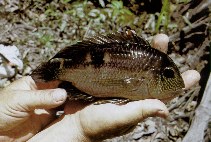
This species is moderately large (to c. 14.0 cm) with triserial predorsal scale pattern, relatively long pectoral fin (36.6-44.6% of SL) and 25-26 scales in the E1 row. It is most similar to A. tubicen, both of which have an enhanced, wide light spot anterior to the caudal spot, lateral band high on side, posteriorly positioned midlateral spot, and high vertebral count (14 + 13 = 27). A. pallidus differs from A. tubicen in the colour pattern, having a supraorbital spot, (vs. none in A. tubicen) and a normal cheek spot (A. tubicen has a preopercular spot). In this species the posterior part of the lateral band is uninterrupted at all sizes (vs. divided into blotches in A. tubicen). Aequidens pallidus, though resembling A. diadema, can be distinguished from the latter by having higher E1 scale row count 25-26 (vs. 24); much narrower dark margins on dorsal flank scales; and, more posteriorly positioned midlateral spot (through E3 scales 12-15 instead of c. 10-13) (Ref. 86501).
Body shape (shape guide): fusiform / normal.
Collected from lotic black to clear water: in Rio Uatumá, this species was collected from marginal pools in rapids after the Balbina dam was closed and the river level dropped considerably below normal low water Ievel; Río Preto da Eva site was a relatively slow flowing small forest stream, while the Igarape Tarumázinho site was a swift flowing forest stream. Although collections indicate swamps and lakes, this species has been collected mostly in running water. Reported food items of specimens from Río Negro were chiefly fish and detritus (Ref. 86501). Inhabits rivers (Ref. 12251). Maximum length 20.0 cm TL (Ref. 40602).
วงจรชีวิตและพฤติกรรมการผสมพันธุ์
วัยเจริญพันธุ์ | การสืบพันธุ์ | การวางไข่ | เซลสืบพันธ์ของเพศเมีย(ไข่) | ความดกของไข่ | ตัวอ่อน
Not a larvophil mouthbrooder (Ref. 40602).
Kullander, S.O., 2003. Cichlidae (Cichlids). p. 605-654. In R.E. Reis, S.O. Kullander and C.J. Ferraris, Jr. (eds.) Checklist of the Freshwater Fishes of South and Central America. Porto Alegre: EDIPUCRS, Brasil. (Ref. 36377)
สถานะบัญชีแดงของ IUCN (Ref. 130435: Version 2025-2 (Global))
ภัยคุกคามต่อมนุษย์
Harmless
การใช้ของมนุษย์
การประมง: การค้า; สถานที่แสดงสัตว์และพืชน้ำ: การค้า
เครื่องมือ
รายงานพิเศษ
ดาวน์โหลด XML
แหล่งที่มาจากอินเตอร์เน็ต
การประมาณค่าตามแบบจำลอง
ดัชนีความหลากหลายทางวิวัฒนาการ (อ้างอิง
82804): PD
50 = 0.5000 [Uniqueness, from 0.5 = low to 2.0 = high].
Bayesian length-weight: a=0.02291 (0.01280 - 0.04101), b=3.17 (3.01 - 3.33), in cm total length, based on LWR estimates for this species & (Sub)family-body (Ref.
93245).
ระดับชั้นอาหาร (อ้างอิง
69278): 3.2 ±0.5 se; based on size and trophs of closest relatives
ความสามารถในการกลับคืนสู่ปกติ (อ้างอิง
120179): ขนาดกลาง, เวลาต่ำสุดที่จะทำให้ประชากรเพิ่มขึ้นเป็น 2 เท่าใช้เวลา 1.4 - 4.4 ปี (Assuming Fec<1000).
ความเสี่ยงต่อการตกปลา (Ref.
59153): Low vulnerability (10 of 100).
🛈