>
Blenniiformes (Blennies) >
Blenniidae (Combtooth blennies) > Blenniinae
Etymology: Meiacanthus: Greek, meion = less = lessen + Greek, akantha = thorn (Ref. 45335); limbatus: Specific epithet means 'bordered' referring to the dark stripe at the base of the anal fin.
Milieu: milieu / Klimaatzone / Diepte / verspreidingsgebied
Ecologie
marien demersaal; diepte 25 - 55 m (Ref. 123060). Tropical
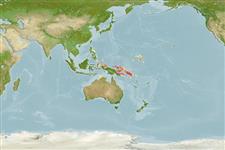
Western Central Pacific: Indonesia, Papua New Guinea and Palau.
Grootte / Gewicht / Leeftijd
Maturiteit: Lm ? range ? - ? cm
Max length : 3.7 cm SL mannelijk / geslacht onbekend; (Ref. 7401)
Korte beschrijving
Determinatiesleutels | Morfologie | Morfometrie
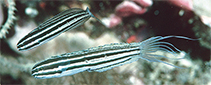
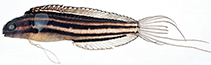
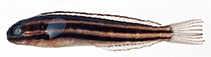
Dorsale stekels (totaal) : 4 - 5; Dorsale zachte stralen (totaal) : 24 - 27; Anale stekels: 2; Anale zachte stralen: 16 - 18. This species is distinguished by the following characters: a major portion of dentary gland dorsally positioned and held in place laterally by a dorsolateral flange of dentary; D IV-V,24-27 (usually IV,26-27); A II,16-18; pectoral-fin rays 13-15, usually 14; in adult males, inner caudal-fin rays produced as filaments. Colouration: a dark mid-lateral stripe that does not extend onto dorsal part of pectoral fin base and only very slightly onto caudal-fin base; a lower dark stripe extending from upper lip through lower half of pectoral fin to base of caudal fin; anal fin of adults with dark basal stripe (best developed in males); pelvic fin sexually dimorphic in adults, depressed fin extends to or beyond anal fin origin in males and about 25-30% of distance to anal-fin origin in females; median supratemporal pores 1 or 2 but surprisingly variable (Ref. 123060).
Cross section: oval.
Adults are found in coral reefs, usually in sheltered inshore reefs (Ref. 41819); described as a gregarious species, with schools as large as 40-50 individuals, some retreating into crevices when disturbed (Ref. 123060), Also in steep outer reef slope (Ref. 90102); typically found in 25-55 m near vertical walls or caves (Ref. 123060). Oviparous. Eggs are demersal and adhesive (Ref. 205), and are attached to the substrate via a filamentous, adhesive pad or pedestal (Ref. 94114). Larvae are planktonic, often found in shallow, coastal waters (Ref. 94114).
Levenscyclus en paargedrag
Maturiteit | Voortplanting | Paaien | Eieren | Fecunditeit | Larven
Oviparous, distinct pairing (Ref. 205).
Smith-Vaniz, W.F. and G.R. Allen, 2019. Meiacanthus solomon, a new fangblenny (Teleostei: Blenniidae) from the Solomon Islands, with a redescription and new records of M. limbatus. J. Ocean Sci. Found. 33:44-52. (Ref. 123060)
Status op de Rode Lijst van het IUCN (Ref. 130435: Version 2025-2 (Global))
Gevaar voor de mens
Harmless
Gebruik door de mens
Tools
Speciale rapporten
Download XML
Internetbronnen
Schattingen op basis van modellen
Gewenste temperatuur (Ref.
123201): 24.2 - 29.1, mean 28.4 °C (based on 8 cells).
Fylogenetische diversiteitsindex (Ref.
82804): PD
50 = 0.5000 [Uniqueness, from 0.5 = low to 2.0 = high].
Bayesian length-weight: a=0.00575 (0.00255 - 0.01297), b=3.06 (2.87 - 3.25), in cm total length, based on LWR estimates for this (Sub)family-body shape (Ref.
93245).
Trofisch niveau (Ref.
69278): 3.2 ±0.4 se; based on size and trophs of closest relatives
Weerstandsvermogen (Ref.
120179): Hoog, minimale populatieverdubbelingstijd minder dan 15 maanden (Preliminary K or Fecundity.).
Kwetsbaarheid van de visserij (Ref.
59153): Low vulnerability (10 of 100).
🛈