>
Blenniiformes (Blennies) >
Blenniidae (Combtooth blennies) > Blenniinae
Etymology: Meiacanthus: Greek, meion = less = lessen + Greek, akantha = thorn (Ref. 45335); tongaensis: Specific epithet refers to Tonga Is., where it appears to be endemic.
Ambiente: milieu / zona climatica / distribuzione batimetrica / gamma di distribuzione
Ecologia
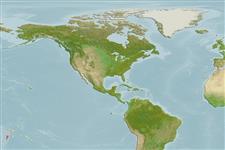
marino pelagic-neritic; distribuzione batimetrica 0 - 16 m (Ref. 7401). Tropical
Pacific Ocean: apparently endemic to Tonga.
Dimensione / Peso / Età
Maturità: Lm ? range ? - ? cm
Max length : 10.0 cm SL maschio/sesso non determinato; (Ref. 54980)
Breve descrizione
Chiavi di identificazione | Morfologia | Morfometria
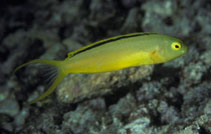
Spine dorsali (totale) : 4; Raggi dorsali molli (totale) : 27 - 28; Spine anali: 2; Raggi anali molli: 17 - 18. Lunate caudal fin with elongated lobes in adults; yellowish green on head and dorsally on body, shading to light yellow ventrally; greenish yellow dorsal and anal fins, broad black stripe near dorsal fin base; caudal fin base and lobes greenish yellow with centroposterior part transparent with pale greenish yellow rays. Segmented caudal rays 11-12 (usually 11); lateral line terminating below 3rd to 7th dorsal soft rays (Ref. 54980).
Body shape (shape guide): elongated.
Oviparous. Eggs are demersal and adhesive (Ref. 205), and are attached to the substrate via a filamentous, adhesive pad or pedestal (Ref. 94114). Larvae are planktonic, often found in shallow, coastal waters (Ref. 94114).
Ciclo vitale e comportamento di accoppiamento
Maturità | Riproduzione | Deposizione | Uova | Fecondità | Larve
Oviparous, distinct pairing (Ref. 205).
Smith-Vaniz, W.F., 1987. The saber-toothed blennies, tribe Nemophini (Pisces: Bleniidae): an update. Proc. Acad. Nat. Sci. Philad. 139:1-52. (Ref. 7401)
Stato della Lista Rossa IUCN (Ref. 130435: Version 2025-2 (Global))
Minaccia per l'uomo
Harmless
Usi umani
Strumenti
Rapporti speciali
Scarica XML
Fonti Internet
Stime basate su modelli
Temperatura preferita (Fonte Biblio.
123201): 25.6 - 29.1, mean 28.1 °C (based on 91 cells).
Indice di diversità filogenetica (Fonte Biblio.
82804): PD
50 = 0.5000 [Uniqueness, from 0.5 = low to 2.0 = high].
Bayesian length-weight: a=0.00575 (0.00255 - 0.01297), b=3.06 (2.87 - 3.25), in cm total length, based on LWR estimates for this (Sub)family-body shape (Ref.
93245).
Livello trofico (Fonte Biblio.
69278): 3.5 ±0.5 se; based on size and trophs of closest relatives
Resilienza (Fonte Biblio.
120179): Alto, tempo minimo di raddoppiamento della popolazione meno di 15 mesi (Preliminary K or Fecundity.).
Vulnerabilità della pesca (Ref.
59153): Low vulnerability (10 of 100).
🛈
Nutrienti (Ref.
124155): Calcium = 396 [203, 771] mg/100g; Iron = 1.91 [1.10, 3.39] mg/100g; Protein = 17.5 [16.2, 18.5] %; Omega3 = 0.152 [0.074, 0.313] g/100g; Selenium = 26.5 [11.0, 63.6] μg/100g; VitaminA = 64.1 [18.4, 225.5] μg/100g; Zinc = 2.33 [1.54, 3.42] mg/100g (wet weight);