>
Blenniiformes (Blennies) >
Blenniidae (Combtooth blennies) > Blenniinae
Etymology: Meiacanthus: Greek, meion = less = lessen + Greek, akantha = thorn (Ref. 45335).
Eponymy: Not a true eponym as this is after a character in Greek mythology; Procne (sometimes Progne – see below), a daughter of King Pandion of Athens. She was metamorphosed into a swallow. The name is used for species which have some ‘swallow-like’ attribute. (Ref. 128868), visit book page.
Environnement : milieu / zone climatique / profondeur / gamme de distribution
Écologie
marin récifal; profondeur 0 - 16 m (Ref. 58018). Tropical
Pacific Ocean: apparently endemic to Tonga.
Taille / Poids / Âge
Maturité: Lm ? range ? - ? cm
Max length : 7.0 cm SL mâle / non sexé; (Ref. 54980)
Description synthétique
Clés d'identification | Morphologie | Morphométrie
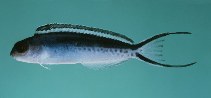
Épines dorsales (Total) : 4 - 5; Rayons mous dorsaux (Total) : 25 - 26; Épines anales: 2; Rayons mous anaux: 15 - 16. Lunate caudal fin with elongated lobes in both sexes; upper half of body bluish black and lower half abruptly bluish white, posteriorly with few small black spots; dorsal fin basal half black with pale blue stripe composed of 1 spot per membrane broadly joined to the next ; outer half of fin bluish gray with pale thin blue margin and black submarginal line; caudal fin base and lobes black with pale blue upper and lower margins, centroposterior part of fin transparent with dusky rays; pectoral-fin axil without dark spot. Dorsal rays IV-V (rarely IV), 25-26; pectoral soft rays rarely 13; segmented caudal rays 11-12 (typically 11); lateral line present (Ref. 54980).
Body shape (shape guide): elongated.
Oviparous. Eggs are demersal and adhesive (Ref. 205), and are attached to the substrate via a filamentous, adhesive pad or pedestal (Ref. 94114). Larvae are planktonic, often found in shallow, coastal waters (Ref. 94114).
Cycle de vie et comportement reproducteur
Maturité | Reproduction | Frai | Œufs | Fécondité | Larves
Oviparous, distinct pairing (Ref. 205).
Smith-Vaniz, W.F., 1987. The saber-toothed blennies, tribe Nemophini (Pisces: Bleniidae): an update. Proc. Acad. Nat. Sci. Philad. 139:1-52. (Ref. 7401)
Statut dans la liste rouge de l'IUCN (Ref. 130435: Version 2025-2 (Global))
Menace pour l'homme
Harmless
Utilisations par l'homme
Outils
Articles particuliers
Télécharger en XML
Sources Internet
Estimations basées sur des modèles
Indice de diversité phylogénétique (Réf.
82804): PD
50 = 0.5000 [Uniqueness, from 0.5 = low to 2.0 = high].
Bayesian length-weight: a=0.00575 (0.00255 - 0.01297), b=3.06 (2.87 - 3.25), in cm total length, based on LWR estimates for this (Sub)family-body shape (Ref.
93245).
Niveau trophique (Réf.
69278): 3.4 ±0.4 se; based on size and trophs of closest relatives
Résilience (Réf.
120179): Haut, temps minimum de doublement de population inférieur à 15 mois (Preliminary K or Fecundity.).
Vulnérabilité de la pêche (Ref.
59153): Low vulnerability (10 of 100).
🛈