>
Acipenseriformes (Sturgeons and paddlefishes) >
Acipenseridae (Sturgeons)
Etymology: Acipenser: Latin, acipenser = sturgeon, 1853 (Ref. 45335).
Eponymy: Karl Ernst von Baer (Karl Maksimovich) (1792–1876) was a versatile and well-travelled Estonian of German extraction, a naturalist and explorer of Siberia, Novaya Zemlya and the Caspian Sea region. [...] (Ref. 128868), visit book page.
Milieu: milieu / Klimaatzone / Diepte / verspreidingsgebied
Ecologie
; zoet water; brak water demersaal; pH range: 7.0 - 7.5; dH range: ? - 20; potamodroom (Ref. 57765); diepte 0 - 200 m (Ref. 57765), usually 1 - 8 m (Ref. 57765). Temperate; 1°C - 19°C (Ref. 57765); 74°N - 46°N, 64°E - 162°E
Asia: Siberia, rivers Ob, Irtysh, Yenisei, Lena, Kolyma, Khatanga, Pyasina, Anabar, Olenyok, Yana and Lake Baikal (Ref. 57765). Non-migratory populations exist in all river systems (Ref. 57765).
Lengte bij maturiteit / Grootte / Gewicht / Leeftijd
Maturiteit: Lm 95.5, range 65 - 167 cm
Max length : 200 cm TL mannelijk / geslacht onbekend; (Ref. 40476); max. gepubliceerd gewicht: 210.0 kg (Ref. 59043); max. gerapporteerde leeftijd: 63 Jaren (Ref. 57765)
Korte beschrijving
Determinatiesleutels | Morfologie | Morfometrie
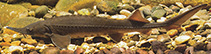
Extended snouts; four barbels in front of the mouth (Ref. 4639). The back is light grey to dark brown colored. The belly color varies from white to clear yellow. Five row s of scutes: 10-19D, 32-59L, 7-16V. Small star-like scutes between the main ones. Clearly slit inferior lip (Ref. 40476).
Body shape (shape guide): elongated.
Found in deep and shallow parts of rivers, with moderate to swift current usually at depths of 1 to 8 m (Ref. 57765). Adults live essentially in freshwater although some fish frequently occur in estuaries. Males are sexually mature between 9 and 29 years; females between 9 and 34 years (Ref. 57765). Spawn in main river channel over stone-gravel or gravel-sand bottom and with strong current (Ref. 59043).
Potamodromous species (Ref. 57765). In a natural environment, males reach sexual maturity at 9-1 5 years of age and females at 16-20 years (in water recirculation systems, sexual maturity can first occur at 5 years). Spawning happens in the summer and generally every two years. Membranes on eggs become increasingly more sticky after fertilization and this allows them to stick to the substratum. This can become a problem in nurseries, but it is solved by washing the eggs in clay or diatomaceous earth suspensions. Caviar (not fecundated ovocites ) can be over 1 0% of the corporal weight of a mature female. Incubation
lasts about 1 6 days (at 10-1 5°). Larval development lasts about 20 days (at 18°). Egg size 3.0-3.6 mm, larval length at hatching 10-12 mm.
Baillie, J. and B. Groombridge (eds.), 1996. 1996 IUCN red list of threatened animals. IUCN, Gland, Switzerland. 378 p. (Ref. 12255)
Status op de Rode Lijst van het IUCN (Ref. 130435: Version 2025-2 (Global))
Gevaar voor de mens
Harmless
Gebruik door de mens
Visserij: van groot commercieel belang; Aquacultuur: commercieel; Aquarium: Publieke aquaria
Tools
Speciale rapporten
Download XML
Internetbronnen
Schattingen op basis van modellen
Fylogenetische diversiteitsindex (Ref.
82804): PD
50 = 0.5000 [Uniqueness, from 0.5 = low to 2.0 = high].
Bayesian length-weight: a=0.00263 (0.00154 - 0.00450), b=3.27 (3.13 - 3.41), in cm total length, based on LWR estimates for this species & Genus-body shape (Ref.
93245).
Trofisch niveau (Ref.
69278): 3.3 ±0.2 se; based on diet studies.
Weerstandsvermogen (Ref.
120179): Zeer laag, minimale populatieverdubbelingstijd meer dan 14 jaar (tm=7-34; tmax=63; Fec=16,500-420,000; K=0.03).
Kwetsbaarheid van de visserij (Ref.
59153): Very high vulnerability (87 of 100).
🛈
Voedingsstoffen (Ref.
124155): Calcium = 15.6 [9.1, 26.8] mg/100g; Iron = 0.253 [0.156, 0.402] mg/100g; Protein = 17.3 [14.8, 20.1] %; Omega3 = 0.381 [0.218, 0.653] g/100g; Selenium = 25.6 [13.5, 47.2] μg/100g; VitaminA = 6.04 [2.17, 16.19] μg/100g; Zinc = 0.514 [0.371, 0.719] mg/100g (wet weight);