>
Eupercaria/misc (Various families in series Eupercaria) >
Labridae (Wrasses) > Julidinae
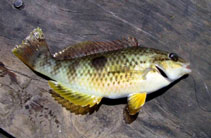
Etymology: Notolabrus: Greek, noton = back + Greek, labros = voracious (Ref. 45335); celidotus: Specific epithet, Greek word 'kelidos' meaning stain or spot, 'otos' meaning ear, referring to the dark markings behind the ears.
More on authors: Bloch & Schneider.
Taxonomic Remarks
Genus to be changed (Ref. 138156). Waiting for nomenclature confirmation.
Umwelt: Milieu / Klimazone / Tiefenbereich / Verbreitungsgebiet
Ökologie
seewasser; brackwasser riff-verbunden; tiefenbereich 22 - 145 m (Ref. 58489). Temperate
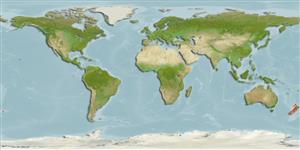
Southwest Pacific: New Zealand, including Stewart Island, but not recorded from Snares Islands, Clatham Islands, nor the Three Kings Islands.
Größe / Gewicht / Alter
Geschlechtsreife: Lm ? range ? - ? cm
Max length : 23.9 cm SL Männchen/unbestimmt; (Ref. 26203); max. veröff. Alter: 7 Jahre (Ref. 31614)
Kurzbeschreibung
Bestimmungsschlüssel | Morphologie | Morphometrie
Inhabits shallow water, but may reach to depths of 145 m (Ref. 26203). Feeds on small benthic organisms. Uses its forward-jutting front teeth to rake food from the substrate (Ref. 26966).
Lebenszyklus und Paarungsverhalten
Geschlechtsreife | Fortpflanzung | Ablaichen | Eier | Fruchtbarkeit | Larven
Pelagic spawner. Also Ref. 27221.
Russell, B.C., 1988. Revision of the labrid fish genus Pseudolabrus and allied genera. Rec. Aust. Mus. (Suppl. 9):1-72. (Ref. 26203)
IUCN Rote Liste Status (Ref. 130435: Version 2025-2 (Global))
Bedrohung für Menschen
Harmless
Nutzung durch Menschen
Tools
Zusatzinformationen
Download XML
Internet Quellen
Schätzungen auf der Grundlage von Modellen
Bevorzugte Temperatur (Ref.
123201): 10 - 18, mean 14.3 °C (based on 49 cells).
Phylogenetischer Diversitätsindex (Ref.
82804): PD
50 = 0.5078 [Uniqueness, from 0.5 = low to 2.0 = high].
Bayesian length-weight: a=0.00794 (0.00456 - 0.01384), b=3.07 (2.92 - 3.22), in cm total length, based on LWR estimates for this species & (Sub)family-body (Ref.
93245).
Trophische Ebene (Ref.
69278): 3.4 ±0.3 se; based on diet studies.
Generation time: 3.0 ( na - na) years. Estimated as median ln(3)/K based on 1
growth studies.
Widerstandsfähigkeit (Ref.
120179): mittel, Verdopplung der Population dauert 1,4 - 4,4 Jahre. (tmax=7; k >0.30).
Anfälligkeit der Fischerei (Ref.
59153): Low vulnerability (19 of 100).
🛈
Nährstoffe (Ref.
124155): Calcium = 19.7 [8.1, 36.6] mg/100g; Iron = 0.214 [0.115, 0.460] mg/100g; Protein = 19 [16, 21] %; Omega3 = 0.473 [0.250, 0.907] g/100g; Selenium = 7.31 [2.99, 17.42] μg/100g; VitaminA = 72.9 [17.0, 386.1] μg/100g; Zinc = 0.824 [0.529, 1.571] mg/100g (wet weight);