Environnement : milieu / zone climatique / profondeur / gamme de distribution
Écologie
marin récifal; profondeur 0 - 154 m (Ref. 93606). Temperate
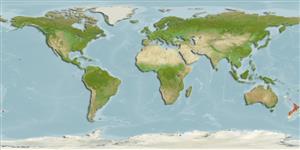
Southwest Pacific: northern New Zealand and offshore islands of the Tasman Sea (Norfolk and Lord Howe Islands, Middleton and Elizabeth Reefs, New South Wales, Australia; not recorded from the coastal waters of Australian mainland).
Taille / Poids / Âge
Maturité: Lm ? range ? - ? cm
Max length : 40.5 cm TL mâle / non sexé; (Ref. 93630); âge max. reporté: 33 années (Ref. 93630)
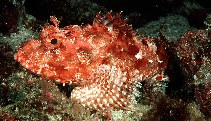
Rayons mous dorsaux (Total) : 8 - 9. This species is distinguished by the following set of characters: D 9 (8 rays in one specimen), with the 4th (rarely third) dorsal-fin spine longest; pectoral-fin rays 16-18 (mode 17); scale rows in longitudinal series 60-74 (68); pored lateral-line scales 23-25 (24); scales above lateral line 6-9 (8), below 21-26 (22); scale rows between 6th dorsal-fin spine base and lateral line 8 or 9 (9); scale rows between last dorsal-fin spine base and lateral line 8-11 (10); pre-dorsal scale rows 4-8 (6); gill rakers on upper limb 4-6 (5), lower limb 9-13 (12) [8-10 (9) and 1-4 (3) rakers on ceratohyal and hypobranchial, respectively], total rakers 14-18 (17); exposed cycloid scales covering pectoral-fin base and anteroventral surface of body (some scales covered by thin skin, especially in large adults); no longitudinal ridge on lateral surface of maxilla; lateral lacrimal spine with 2 spinous points; anterior lacrimal spine with 1-3 small spinous points on its posterior margin; posterior lacrima spine with 1-3 spinous points, directed posteroventraly throughout life; median interorbital ridge present; no coonal spines; occipital pit and supplement preopercular spine present; pterotic spine simple, smooth distally throughout life; space between upper and lower opercular spines covered by thin skin without sensory pores or canals; a few skin flaps or tentacles on anterodorsal surface of body; without a large black blotch on spinous portion of dorsal fin in both sexes; 2 large white blotches, their diameters subequal to pupil diameter, on caudal-fin base (Ref. 93606).
Body shape (shape guide): short and / or deep; Cross section: compressed.
Inhabits rocks, crevices and caverns at all depths. Occasionally found in large rock pools in the lower littoral zone. Is nocturnally active and feeds mainly on small mobile benthic animals. Stalks its prey and swallows it whole (Ref. 26966).
Cycle de vie et comportement reproducteur
Maturité | Reproduction | Frai | Œufs | Fécondité | Larves
Motomura, H., C.D. Struthers, M.A. McGrouther and A.L. Stewart, 2011. Validity of Scorpaena jacksoniensis and a redescription of S. cardinalis, a senior synonym of S. cookii (Scorpaeniformes: Scorpaenidae). Ichthyol. Res. 58 (4):315-332. (Ref. 93606)
Statut dans la liste rouge de l'IUCN (Ref. 130435: Version 2025-2 (Global))
Menace pour l'homme
Harmless
Utilisations par l'homme
Outils
Articles particuliers
Télécharger en XML
Sources Internet
Estimations basées sur des modèles
Température préférée (Réf.
123201): 16 - 22.6, mean 17.6 °C (based on 56 cells).
Indice de diversité phylogénétique (Réf.
82804): PD
50 = 0.5000 [Uniqueness, from 0.5 = low to 2.0 = high].
Bayesian length-weight: a=0.01445 (0.00715 - 0.02923), b=3.09 (2.90 - 3.28), in cm total length, based on LWR estimates for this species & (Sub)family-body (Ref.
93245).
Niveau trophique (Réf.
69278): 3.5 ±0.5 se; based on diet studies.
Résilience (Réf.
120179): Faible, temps minimum de doublement de population : 4,5 à 14 années (K=0.09; tmax=33).
Vulnérabilité de la pêche (Ref.
59153): Low to moderate vulnerability (31 of 100).
🛈
Nutriments (Ref.
124155): Calcium = 23.2 [8.8, 51.0] mg/100g; Iron = 0.224 [0.102, 0.453] mg/100g; Protein = 18.3 [16.4, 20.1] %; Omega3 = 0.494 [0.194, 1.682] g/100g; Selenium = 8.03 [3.45, 19.91] μg/100g; VitaminA = 62.4 [13.7, 313.0] μg/100g; Zinc = 0.615 [0.374, 0.971] mg/100g (wet weight);