Taxonomic Remarks
Mugil amarulus Valenciennes, 1936, Mugil kelaartii Günther, 1861, and Mugil longimanus Günther, 1861 are synonyms of Moolgarda perusii (Valenciennes, 1836) according to Eschmeyer (CofF ver Jan. 2013: Ref. 92887).
Environnement : milieu / zone climatique / profondeur / gamme de distribution
Écologie
marin; eau douce; saumâtre démersal; catadrome (Ref. 26213); profondeur 0 - 3 m (Ref. 86942). Tropical
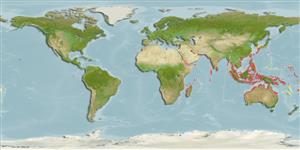
Indo-West Pacific (Ref. 4393), including African east coast river estuaries as far south as Algoa Bay, South Africa (Ref. 52193). Recorded as far inland as Zimbabwe on the Save River (Ref. 52193).
Longueur à la première maturité / Taille / Poids / Âge
Maturité: Lm 15.1 range ? - ? cm
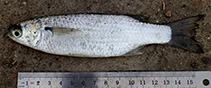
Max length : 41.0 cm SL mâle / non sexé; (Ref. 52193); common length : 25.0 cm TL mâle / non sexé; (Ref. 30573)
Épines dorsales (Total) : 4 - 5; Rayons mous dorsaux (Total) : 9 - 10; Épines anales: 2 - 3; Rayons mous anaux: 9.
Body shape (shape guide): fusiform / normal; Cross section: circular.
Occur in shallow coastal waters, including estuaries and backwaters, frequently enters freshwater. Form larger aggregations during spawning which takes place at sea. Young individuals enter tidal rivers. Feed on organic matter contained in sand and mud (Ref. 30573). Oviparous, eggs are pelagic and non-adhesive (Ref. 205). Marketed fresh and salted. Decays rapidly, but well liked when fresh.
Cycle de vie et comportement reproducteur
Maturité | Reproduction | Frai | Œufs | Fécondité | Larves
Thomson, J.M., 1984. Mugilidae. In W. Fischer and G. Bianchi (eds.) FAO species identification sheets for fishery purposes. Western Indian Ocean (Fishing Area 51). volume 3. [pag. var.]. FAO, Rome. (Ref. 2830)
Statut dans la liste rouge de l'IUCN (Ref. 130435: Version 2025-2 (Global))
Menace pour l'homme
Harmless
Utilisations par l'homme
Pêcheries: commercial; appât: usually
Outils
Articles particuliers
Télécharger en XML
Sources Internet
Estimations basées sur des modèles
Température préférée (Réf.
123201): 24.8 - 29.3, mean 28.5 °C (based on 2356 cells).
Indice de diversité phylogénétique (Réf.
82804): PD
50 = 0.5156 [Uniqueness, from 0.5 = low to 2.0 = high].
Bayesian length-weight: a=0.01148 (0.00996 - 0.01324), b=2.95 (2.91 - 2.99), in cm total length, based on LWR estimates for this species (Ref.
93245).
Niveau trophique (Réf.
69278): 2.4 ±0.21 se; based on food items.
Résilience (Réf.
120179): Milieu, temps minimum de doublement de population : 1,4 à 4,4 années (K=0.3-0.7;).
Vulnérabilité de la pêche (Ref.
59153): Low to moderate vulnerability (34 of 100).
🛈
Nutriments (Ref.
124155): Calcium = 217 [97, 488] mg/100g; Iron = 1.38 [0.63, 2.91] mg/100g; Protein = 18.3 [16.7, 20.0] %; Omega3 = 0.253 [0.124, 0.558] g/100g; Selenium = 33.3 [15.6, 75.8] μg/100g; VitaminA = 15.9 [4.5, 50.4] μg/100g; Zinc = 1.87 [1.25, 2.78] mg/100g (wet weight);