>
Perciformes/Notothenioidei (Icefishes) >
Nototheniidae (Cod icefishes) > Nototheniinae
Etymology: Notothenia: Greek, 'notos', ou; νοτος, ου), from the south + Greek, 'e 'eutheneia',as or 'euthenia', as (ευθενεια, ας; ευθενια, ας), abundance (P. Romero, pers.comm. 01/16); coriiceps: coriiceps from Latin corium skin or leather plus ceps head = skin head or leather head (Ref. 11892).
More on author: Richardson.
Environnement : milieu / zone climatique / profondeur / gamme de distribution
Écologie
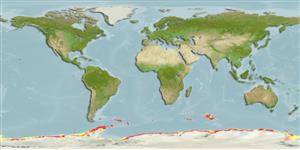
marin démersal; profondeur 0 - 550 m. Polar; 46°S - 78°S, 180°W - 180°E
Southern Ocean: probably circum-Antarctic on the continental shelf. So far, known from the western Ross Sea, Balleny islands, Adélie Land, Antarctic Peninsula and associated islands, islands of the Scotia Arc to South Georgia, Weddell Sea, Bouvet, and the sub-Antarctic islands of the Indian Ocean sector.
Longueur à la première maturité / Taille / Poids / Âge
Maturité: Lm 36.5 range ? - ? cm
Max length : 62.0 cm TL mâle / non sexé; (Ref. 5179); common length : 50.0 cm TL mâle / non sexé; (Ref. 2121)
Description synthétique
Clés d'identification | Morphologie | Morphométrie
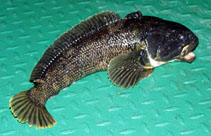
Épines dorsales (Total) : 4 - 6; Rayons mous dorsaux (Total) : 35 - 38; Rayons mous anaux: 26 - 30. Wide interorbital space, fewer pectoral rays, lack of scales below the eye (Ref. 11892).
Body shape (shape guide): fusiform / normal.
Most commonly found in less than 200 m (Re. 5179). Stomach contents included
mainly small crustaceans (Amphipoda and Euphausiacea) and seaweeds (Ref. 122792).
Cycle de vie et comportement reproducteur
Maturité | Reproduction | Frai | Œufs | Fécondité | Larves
Dewitt, H.H., P.C. Heemstra and O. Gon, 1990. Nototheniidae. p. 279-331. In O. Gon and P.C. Heemstra (eds.) Fishes of the Southern Ocean. J.L.B. Smith Institute of Ichthyology, Grahamstown, South Africa. (Ref. 5179)
Statut dans la liste rouge de l'IUCN (Ref. 130435: Version 2025-2 (Global))
Menace pour l'homme
Harmless
Utilisations par l'homme
Pêcheries: d'intérêt potentiel
Outils
Articles particuliers
Télécharger en XML
Sources Internet
Estimations basées sur des modèles
Température préférée (Réf.
123201): -1.7 - 2.4, mean -0.6 °C (based on 170 cells).
Indice de diversité phylogénétique (Réf.
82804): PD
50 = 0.5312 [Uniqueness, from 0.5 = low to 2.0 = high].
Bayesian length-weight: a=0.00661 (0.00543 - 0.00804), b=3.22 (3.16 - 3.28), in cm total length, based on LWR estimates for this species (Ref.
93245).
Niveau trophique (Réf.
69278): 2.8 ±0.35 se; based on food items.
Résilience (Réf.
120179): Faible, temps minimum de doublement de population : 4,5 à 14 années (Assuming tm>4).
Vulnérabilité de la pêche (Ref.
59153): High vulnerability (60 of 100).
🛈
Vulnérabilité climatique (Ref.
125649): Moderate to high vulnerability (50 of 100).
🛈
Nutriments (Ref.
124155): Calcium = 20.8 [12.1, 47.6] mg/100g; Iron = 0.412 [0.189, 0.797] mg/100g; Protein = 18 [16, 20] %; Omega3 = 0.326 [0.178, 0.568] g/100g; Selenium = 18.9 [7.9, 43.2] μg/100g; VitaminA = 9.04 [2.05, 41.45] μg/100g; Zinc = 0.491 [0.330, 0.740] mg/100g (wet weight);