>
Eupercaria/misc (Various families in series Eupercaria) >
Haemulidae (Grunts) > Haemulinae
Etymology: Pomadasys: Greek, poma, -atos = cover, operculum + Greek, dasys = with hair (Ref. 45335).
Eponymy: Jean Jubelin (1787–1860) was the French governor of Senegal (1828–1829) at the time this fish was discovered there. After his tenure in Senegal, he became governor of French Guiana. (Ref. 128868), visit book page.
More on author: Cuvier.
Milieu: milieu / Klimaatzone / Diepte / verspreidingsgebied
Ecologie
marien; zoet water; brak water demersaal; diepte ? - 100 m (Ref. 57395), usually 20 - 50 m (Ref. 2683). Tropical; 20°C - ? (Ref. 2799); 20°N - 23°S, 26°W - 16°E
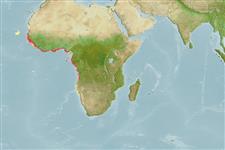
Eastern Atlantic: west coast of Africa, from Mauritania (Ref. 7376, 57395) to southern Angola (Ref. 2799, 57395).
Lengte bij maturiteit / Grootte / Gewicht / Leeftijd
Maturiteit: Lm 13.1 range ? - ? cm
Max length : 60.0 cm TL mannelijk / geslacht onbekend; (Ref. 57395); common length : 45.0 cm TL mannelijk / geslacht onbekend; (Ref. 3660)
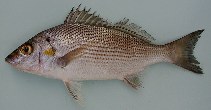
Dorsale stekels (totaal) : 11 - 12; Dorsale zachte stralen (totaal) : 15 - 17; Anale stekels: 3; Anale zachte stralen: 8 - 9; Wervels: 27. Diagnosis: body oblong and compressed, not very deep (Ref. 57395). Snout short and pointed (Ref. 57395), obtuse (Ref. 81655), distinctly longer than eye diameter (Ref. 57395). 2 anterior pores on chin, followed by a median pit bearing openings of another pair of pores (Ref. 57395). A deep groove (Ref. 57395) and a pore above maxilla, below the preorbital bone (Ref. 57395, 81655). Last dorsal spine longer than penultimate one (Ref. 81655). Second anal fin spine longer and stouter than third (Ref. 57395, 81655), third anal spine may also be thick but always shorter (Ref. 81655). Caudal fin slightly forked; scales slightly ctenoid; 4-5 scale rows between lateral line and middle of spinous dorsal-fin base; swim bladder simple, without anterior horns (Ref. 57395). 11-13/1/3-6 (total 16-20) gill rakers on first gill arch; 6-7 scales on upper part of transverse series; 20-22 scales around middle of caudal peduncle (Ref. 81655).
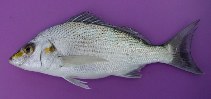
Coloration: silvery, with round, dark brown or black and irregularly scattered spots following scale rows on back and sides (Ref. 57395, 81655). Small-sized specimens <60 mm SL may lack spots, from this size on spots gradually become visible and pattern is well-developed in specimens of about 100 mm SL or larger; no spot on snout (Ref. 81655). Black opercular spot present at angle of opercle (Ref. 57395, 81655). Dorsal and caudal fins grey (Ref. 57395).
Body shape (shape guide): fusiform / normal.
Inhabit sandy and muddy bottoms of coastal waters and estuaries (Ref. 2683). Sometimes found in freshwater (Ref. 2135, 57395, 81655). Feeds on fish (Ref. 28587) and (benthic) crustaceans (Ref. 28587, 81655) as well as on mollusks and worms (Ref. 27121, 81655). Breeds in brackish water lagoons and estuaries, and even freshwaters (Ref. 57395). Of all grunts found in the continental waters of Lower Guinea, this species is found farthest upstream and seems best adapted to freshwater environments (Ref. 81655).
Levenscyclus en paargedrag
Maturiteit | Voortplanting | Paaien | Eieren | Fecunditeit | Larven
Oviparous, distinct pairing during breeding (Ref. 205).
Bauchot, M.-L., 2003. Haemulidae. p. 495-503 In C. Lévêque, D. Paugy and G.G. Teugels (eds.) Faune des poissons d'eaux douce et saumâtres de l'Afrique de l'Ouest, Tome 2. Coll. Faune et Flore tropicales 40. Musée Royal de l'Afrique Centrale, Tervuren, Belgique, Museum National d'Histoire Naturalle, Paris, France and Institut de Recherche pour le Développement, Paris, France. 815 p. (Ref. 57395)
Status op de Rode Lijst van het IUCN (Ref. 130435: Version 2025-2 (Global))
Gevaar voor de mens
Harmless
Gebruik door de mens
Visserij: van minder commercieel belang
Tools
Speciale rapporten
Download XML
Internetbronnen
Schattingen op basis van modellen
Gewenste temperatuur (Ref.
123201): 19.2 - 27.9, mean 25.4 °C (based on 82 cells).
Fylogenetische diversiteitsindex (Ref.
82804): PD
50 = 0.5000 [Uniqueness, from 0.5 = low to 2.0 = high].
Bayesian length-weight: a=0.01380 (0.01101 - 0.01731), b=2.97 (2.93 - 3.01), in cm total length, based on LWR estimates for this species (Ref.
93245).
Trofisch niveau (Ref.
69278): 3.6 ±0.51 se; based on food items.
Generation time: 3.7 ( na - na) years. Estimated as median ln(3)/K based on 1
growth studies.
Weerstandsvermogen (Ref.
120179): Gemiddeld, minimale populatieverdubbelingstijd 1,4-4,4 jaar (K=0.3).
Prior r = 0.47, 95% CL = 0.31 - 0.70, Based on 2 data-limited stock assessments.
Kwetsbaarheid van de visserij (Ref.
59153): Moderate vulnerability (36 of 100).
🛈
Kwetsbaarheid voor het klimaat (Ref.
125649): Very high vulnerability (80 of 100).
🛈
Voedingsstoffen (Ref.
124155): Calcium = 106 [23, 206] mg/100g; Iron = 1.02 [0.54, 1.90] mg/100g; Protein = 18.8 [16.9, 20.5] %; Omega3 = 0.235 [0.124, 0.397] g/100g; Selenium = 61.9 [35.8, 110.8] μg/100g; VitaminA = 14.4 [6.9, 27.5] μg/100g; Zinc = 1.22 [0.88, 1.71] mg/100g (wet weight);