>
Cyprinodontiformes (Rivulines, killifishes and live bearers) >
Poeciliidae (Poeciliids) > Poeciliinae
Etymology: Phalloptychus: Greek, phallos = penis * Greek, ptyx, ptychos = fold (Ref. 45335).
Ambiente: milieu / zona climatica / distribuzione batimetrica / gamma di distribuzione
Ecologia
; acqua dolce pelagico; pH range: 6.8 - 8.0; dH range: ? - 25. Tropical; 24°C - 28°C (Ref. 26130)
South America: Brazil, Paraguay, Uruguay and Argentina (Ref. 9086).
Dimensione / Peso / Età
Maturità: Lm ? range ? - ? cm
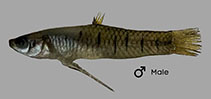
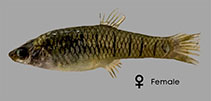
Max length : 2.5 cm SL maschio/sesso non determinato; (Ref. 26130); 4.0 cm (female)
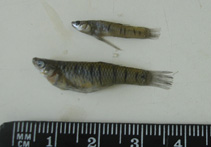
Usually found in shallow, flowing and standing waters that can warm up considerably. Occurs in company with other livebearers, such as Poecilia vivipara and Jenynsia lineata. A photo of this species taken from Santos channel, state of São Paulo, Brazil has a maximum length of 3.3 cm SL (photo by T. Vaske, Jr.).
Ciclo vitale e comportamento di accoppiamento
Maturità | Riproduzione | Deposizione | Uova | Fecondità | Larve
After 24 days gestation, gives birth to 10-30 young.
Wischnath, L., 1993. Atlas of livebearers of the world. T.F.H. Publications, Inc., United States of America. 336 p. (Ref. 26130)
Stato della Lista Rossa IUCN (Ref. 130435: Version 2025-2 (Global))
Minaccia per l'uomo
Harmless
Usi umani
Strumenti
Rapporti speciali
Scarica XML
Fonti Internet
Stime basate su modelli
Indice di diversità filogenetica (Fonte Biblio.
82804): PD
50 = 0.7500 [Uniqueness, from 0.5 = low to 2.0 = high].
Bayesian length-weight: a=0.00891 (0.00480 - 0.01654), b=3.22 (3.06 - 3.38), in cm total length, based on LWR estimates for this species & (Sub)family-body (Ref.
93245).
Livello trofico (Fonte Biblio.
69278): 3.0 ±0.4 se; based on size and trophs of closest relatives
Resilienza (Fonte Biblio.
120179): Alto, tempo minimo di raddoppiamento della popolazione meno di 15 mesi (Preliminary K or Fecundity.).
Vulnerabilità della pesca (Ref.
59153): Low vulnerability (10 of 100).
🛈