>
Cichliformes (Cichlids, convict blennies) >
Cichlidae (Cichlids) > Pseudocrenilabrinae
Etymology: Tilapia: Bechuana, African native thiape = fish (Ref. 45335).
Eponymy: Dr Anders Erikson Sparrman (1748–1820) was a Swedish explorer, collector and naturalist who explored the Cape area of South Africa (1772–1776). [...] (Ref. 128868), visit book page.
Ambiente: milieu / zona climatica / distribuzione batimetrica / gamma di distribuzione
Ecologia
; acqua dolce benthopelagico; pH range: 7.0 - ? ; dH range: 10 - ?; potamodromo (Ref. 126106); distribuzione batimetrica 5 - ? m (Ref. 3). Tropical; 22°C - 25°C (Ref. 2059); 10°S - 30°S
Africa: middle Congo River basin in the Kwilu (Ref. 11970), Kwango, Kasai drainage (Ref. 11970, 55074) and Lomami (Ref. 106245); upper Congo River basin including the Lualaba, upper Lualaba, Lufira, Upemba region, Luvua, Lake Mweru, Luapula (Ref. 55074) and Bangweulu (Ref. 5163, 95585); Cunene, Okavango, Lake Ngami, Zambezi, Limpopo, northern tributaries of the Orange River (Ref. 5163, 11970), Cuvelai (Ref. 120641), upper Cuanza, Sabi, Lundi and Lake Malawi (Ref. 5163).
Dimensione / Peso / Età
Maturità: Lm ? range ? - ? cm
Max length : 23.5 cm TL maschio/sesso non determinato; (Ref. 27292); peso massimo pubblicato: 445.00 g (Ref. 7248)
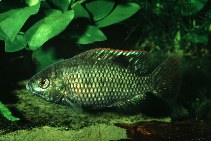
Spine dorsali (totale) : 13 - 15. Diagnosis: A small, deep-bodied species with a narrow head and small strong jaws (Ref. 118638). Often appearing a rich deep yellow with wide dark brown bands, and red/orange fin margins; mature adults are very dark with prominent black stripes and a patch of scarlet scales behind the head (Ref. 118638).
Body shape (shape guide): fusiform / normal; Cross section: oval.
Adults are found in widely diverse habitat (Ref. 3); they favor areas where plant cover exists along the edges of rivers, lakes or swamps (Ref. 3), but tend to be confined to shallow weedy areas, so ithey do not build up large populations in deep lakes (Ref. 118638). They are reported to be cold-confined (Ref. 118638). Adults are omnivorous, feeding on animal and plant matter (Ref. 118638), preferentially on filamentous algae, aquatic macrophytes and vegetable matter of terrestrial origin like leaves, plants, etc. (Ref. 3). Juveniles feed on small crustaceans and midge larvae (Ref. 6465). It is forage fish for bass (Ref. 7248). A substrate spawner (Ref. 52307, 118638). Male and female form pairs to rear the young (Ref. 118638). It undertakes seasonal upstream migration and breeds before and during these migrations (Ref. 13337, 52307). A relatively small species, so unlikely to play much of a role in capture fisheries, but cultured in ponds in Njombe, Tanzania, and apparently stocked into Lake Kiungululu, Tanzania, where it is not presently exploited (Ref. 118638).
Ciclo vitale e comportamento di accoppiamento
Maturità | Riproduzione | Deposizione | Uova | Fecondità | Larve
A substrate spawner (Ref. 118638). Male spreads his milt over the cluster of eggs which are deposited on the bottom or even attached to the branches of aquatic weeds; parents guard the eggs; eggs and fry may be moved into the mouth to alternative sites during hatching operations but there is no evidence of actual mouth brooding (Ref. 13337).
Teugels, G.G. and D.F.E. Thys van den Audenaerde, 1991. Tilapia. p. 482-508. In J. Daget, J.-P. Gosse, G.G. Teugels and D.F.E. Thys van den Audenaerde (eds.) Check-list of the freshwater fishes of Africa (CLOFFA). ISNB, Brussels; MRAC, Tervuren; and ORSTOM, Paris. Vol. 4. (Ref. 5163)
Stato della Lista Rossa IUCN (Ref. 130435: Version 2025-2 (Global))
Minaccia per l'uomo
Harmless
Usi umani
Pesca: pesca di sussistenza; Acquacoltura: commerciale; Pesce da pesca sportiva: si
Strumenti
Rapporti speciali
Scarica XML
Fonti Internet
Stime basate su modelli
Indice di diversità filogenetica (Fonte Biblio.
82804): PD
50 = 0.5078 [Uniqueness, from 0.5 = low to 2.0 = high].
Bayesian length-weight: a=0.01445 (0.00804 - 0.02599), b=2.94 (2.79 - 3.09), in cm total length, based on LWR estimates for this species & (Sub)family-body (Ref.
93245).
Livello trofico (Fonte Biblio.
69278): 2.7 ±0.28 se; based on food items.
Generation time: 2.5 ( na - na) years. Estimated as median ln(3)/K based on 2
growth studies.
Resilienza (Fonte Biblio.
120179): Alto, tempo minimo di raddoppiamento della popolazione meno di 15 mesi (Assuming K>0.3; tm=1).
Vulnerabilità della pesca (Ref.
59153): Low vulnerability (14 of 100).
🛈