>
Perciformes/Notothenioidei (Icefishes) >
Nototheniidae (Cod icefishes) > Pleuragrammatinae
Etymology: Pleuragramma: Greek, pleura = side, ribe + Greek, gramma = letter, signal (Ref. 45335); antarcticum: Named after the region in which this is common (Ref. 11892).
More on author: Boulenger.
Entorno: milieu / zona climática / rango de profundidad / gama de distribución
Ecología
marino pelagic-oceanic; rango de profundidad 0 - 1000 m (Ref. 127764). Polar; ? - 2°C (Ref. 6390); 60°S - 78°S, 180°W - 180°E
Southern Ocean: Antarctic Peninsula, South Shetland, Elephant, South Orkney islands, Weddell, Bellingshausen, Ross and Davis seas, Oates, Adélie, Wilhelm and other coasts of East Antarctica to Prydz Bay.
Longitud en la primera madurez / Tamaño / Peso / Edad
Madurez: Lm ?, range 13 - ? cm
Max length : 26.6 cm TL macho / no sexado; (Ref. 124149); common length : 15.0 cm TL macho / no sexado; (Ref. 2121); peso máximo publicado: 200.00 g (Ref. 6390); edad máxima reportada: 20 años (Ref. 5216)
Espinas dorsales (total) : 6 - 8; Radios blandos dorsales (total) : 35 - 38; Espinas anales: 0; Radios blandos anales: 36 - 39; Vértebra: 52 - 56. Pre-opercular-mandibular canal pores 9 (rarely 10), with 3 (rarely 4) on the mandible. Infraorbital canal with 4+2 pores; lateral line organs (neuromasts) present exposed region between the canal segments, the normal number probably being 4 (rarely 5), but some or all are often missing. Supraorbital canal with 3+1 pores (a second, more posterior pore rarely present in postero-dorsal section); between these 2 supraorbital canal segments is a trough divided by 3 low transverse ridges into 4 shallow depressions; on each ridge is a neuromasts organ. Temporal canal with 1+4 pores; between the 2 segment lies a single exposed neuromast. Supratemporal canal with 1+1 pores; no traces of neuromasts were found in the intervening regions.
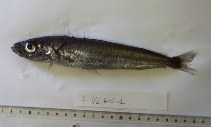
Color: In life, pink with a silvery hue, the dorsal surface slightly darker. All fins pale, with clear hyaline membranes. The body becomes silvery with a darker dorsum only after death (Ref. 28937).
Body shape (shape guide): fusiform / normal; Cross section: oval.
Regarded as the only truly pelagic fish in Antarctic waters (Ref. 6390). Larvae and postlarvae occur between 0 to 135 m; juveniles 50 to 400 and adults below 400 m (Ref. 5179). Postlarvae feed mainly on eggs and larvae of copepods; juveniles mainly on copepods, but take also eggs and larvae of euphausiids, polychaetes and chaetognaths (Ref. 5179). Larger items are ingested with increase in size (Ref. 5179). Larval pelagic phase is long (Ref. 28916).
Mature females may spawn for the first time from around 7-9 years of age (Ref. 71843).
Dewitt, H.H., P.C. Heemstra and O. Gon, 1990. Nototheniidae. p. 279-331. In O. Gon and P.C. Heemstra (eds.) Fishes of the Southern Ocean. J.L.B. Smith Institute of Ichthyology, Grahamstown, South Africa. (Ref. 5179)
Situación en la Lista Roja de la UICN (Ref. 130435: Version 2025-2 (Global))
Amenaza para el ser humano
Harmless
Usos humanos
Pesquerías: escaso valor comercial
Herramientas
Informes especiales
Descargar XML
Fuentes de Internet
Estimaciones basadas en modelos
Temperatura preferida (Referencia
123201): -1.8 - 0.9, mean -1 °C (based on 540 cells).
Índice de diversidad filogenética (Referencia
82804): PD
50 = 1.0000 [Uniqueness, from 0.5 = low to 2.0 = high].
Bayesian length-weight: a=0.00355 (0.00225 - 0.00560), b=3.22 (3.09 - 3.35), in cm total length, based on LWR estimates for this species & (Sub)family-body (Ref.
93245).
Nivel trófico (Referencia
69278): 3.2 ±0.3 se; based on diet studies.
Resiliencia (Referencia
120179): Bajo, población duplicada en un tiempo mínimo de 4.5-14 años (K=0.14; tm=3-4; tmax=20; Fec=4,000).
Vulnerabilidad pesquera (Ref.
59153): Moderate to high vulnerability (52 of 100).
🛈
Vulnerabilidad climática (Ref.
125649): High vulnerability (60 of 100).
🛈
Nutrientes (Ref.
124155): Calcium = 31.8 [16.5, 72.3] mg/100g; Iron = 0.582 [0.268, 1.204] mg/100g; Protein = 16.1 [12.9, 19.0] %; Omega3 = 0.425 [0.227, 0.796] g/100g; Selenium = 11.9 [4.3, 26.7] μg/100g; VitaminA = 30.7 [6.6, 152.8] μg/100g; Zinc = 0.593 [0.386, 0.926] mg/100g (wet weight); based on
nutrient studies.