>
Gobiiformes (Gobies) >
Gobiidae (Gobies) > Gobiinae
Etymology: Neogobius: Greek, neos = new + Latin, gobius = gudgeon (Ref. 45335).
More on author: Pallas.
Ambiente: milieu / zona climatica / distribuzione batimetrica / gamma di distribuzione
Ecologia
; acqua dolce; salmastro benthopelagico. Temperate; 4°C - 20°C (Ref. 2059); 56°N - 36°N, 25°E - 54°E
Eurasia: Azov and Black Sea basins. Invasive in rivers of northern Black Sea basin, recorded in 1997 from middle Vistula (Poland), reaching from Dniepr via a navigation canal. In Danube upriver to Hungary, in Dniepr up to Belurus. Introduced in Lake Balaton, Hungary around 1970.
Dimensione / Peso / Età
Maturità: Lm ? range ? - ? cm
Max length : 20.0 cm SL maschio/sesso non determinato; (Ref. 59043); Età massima riportata: 5 anni (Ref. 59043)
Breve descrizione
Chiavi di identificazione | Morfologia | Morfometria
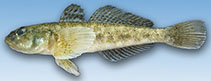
Spine dorsali (totale) : 7; Raggi dorsali molli (totale) : 14 - 18; Spine anali: 1; Raggi anali molli: 12 - 17. This species is distinguished from its congeners entering freshwater in the Black Sea basin by the following characters: first branched ray of second dorsal about twice as long as penultimate ray; completely scaled nape; pelvic-disc fraenum with small rounded lobes and the length is less than 1/6 of width at base; pelvic disc reaching 90-100% of distance between its origin and anus; scales in midlateral series 55-61 + 2-4; posterior part of first dorsal without black spot (Ref. 59043).
Body shape (shape guide): fusiform / normal.
Occurs in inshore habitats, estuaries and brackish- and fresh-water lagoons and lakes; large to medium sized rivers and streams; on sand or mud bottom. It is one of the most abundant fish in lowland rivers. This species lives up to 5 years; spawns for the first time at 2 years; spawning season in April to July, locally until September, when temperature is above 13°C; females may repeat spawning during a season. Males with body completely black with yellow fin margins during the spawning season; these excavate nests under any kind of hard substrate and guard eggs until hatching; with adhesive eggs deposited on stones, shells and aquatic plants. Feeds on a variety of invertebrates, especially molluscs (Ref.59043).
Deposits oval eggs on stones. Male guards the eggs for 3-4 days (Ref.26211).Males have completely black body with yellow fin margins during spawning season. (Ref.59043).
Kottelat, M. and J. Freyhof, 2007. Handbook of European freshwater fishes. Publications Kottelat, Cornol and Freyhof, Berlin. 646 pp. (Ref. 59043)
Stato della Lista Rossa IUCN (Ref. 130435: Version 2025-2 (Global))
Minaccia per l'uomo
Harmless
Usi umani
Pesca: scarso interesse commerciale
Strumenti
Rapporti speciali
Scarica XML
Fonti Internet
Stime basate su modelli
Indice di diversità filogenetica (Fonte Biblio.
82804): PD
50 = 0.5625 [Uniqueness, from 0.5 = low to 2.0 = high].
Bayesian length-weight: a=0.01000 (0.00817 - 0.01224), b=3.03 (2.97 - 3.09), in cm total length, based on LWR estimates for this species (Ref.
93245).
Livello trofico (Fonte Biblio.
69278): 3.4 ±0.1 se; based on diet studies.
Generation time: 2.6 ( na - na) years. Estimated as median ln(3)/K based on 2
growth studies.
Resilienza (Fonte Biblio.
120179): Alto, tempo minimo di raddoppiamento della popolazione meno di 15 mesi (Preliminary K or Fecundity.).
Vulnerabilità della pesca (Ref.
59153): Low vulnerability (21 of 100).
🛈