>
Siluriformes (Catfishes) >
Bagridae (Bagrid catfishes)
Etymology: Bagrus: Mozarabic, bagre, taken from Greek, pagros = a fish (Dentex sp.) (Ref. 45335).
More on author: Günther.
Ambiente: milieu / zona climatica / distribuzione batimetrica / gamma di distribuzione
Ecologia
; acqua dolce demersale; distribuzione batimetrica 0 - 60 m (Ref. 33611). Tropical; 9°S - 15°S
Africa: Endemic to Lake Malawi.
Lunghezza alla prima maturità / Dimensione / Peso / Età
Maturità: Lm 44.5, range 28 - ? cm
Max length : 150 cm SL maschio/sesso non determinato; (Ref. 4967); common length : 42.0 cm TL maschio/sesso non determinato; (Ref. 2781); peso massimo pubblicato: 9.5 kg (Ref. 52161)
Breve descrizione
Chiavi di identificazione | Morfologia | Morfometria
Spine dorsali (totale) : 1; Raggi dorsali molli (totale) : 9 - 10; Raggi anali molli: 14 - 15. Head depressed, smooth or finely striated above; snout not or little projecting beyond lower jaw; premaxillary band of teeth 5-6.5 times as long as broad, nearly as broad as the band of vomerine teeth; maxillary barbel 2(juv.)-1 times head length, reaching to extremity of pelvics or beyond (<200mm), to extremity of pectoral (300-500mm) or hardly beyond gill-opening (>500mm); nasal barbel 2/5 (<100mm)-1/7 (>500mm) head length; outer mandibular barbel 3/4(juv.)-2/5 of head length; inner mandibular barbel 1/2(juv.)-1/5 of head length; gillrakers rather long, widely set (Ref. 52162). Occipital processus long and narrow (Ref. 52162, Ref. 2988). Dorsal fin short, last ray above or just in front of first ray of pelvic; dorsal spine smooth, feeble (Ref. 52162). Adipose fin large (Ref. 52161), 5(juv.)-11 (>600mm) times as long as deep (Ref. 52162). Dorsal fins widely separated (Ref. 4967, Ref. 2899), space 2/3-1 times length of base of rayed dorsal fin; pectoral spine smooth or very slightly serrated; caudal fin deeply forked with pointed lobes (Ref. 52162).
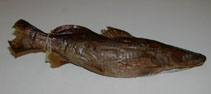
Coloration: brown or olive above, pale beneath, black dots or blotches scattered irregularly on the back, on the adipose dorsal and caudal fins, and sometimes also on the rayed dorsal (Ref. 52162).
Body shape (shape guide): elongated; Cross section: circular.
Occurs from the lower reaches of rivers to the deepest habitable parts of the lake (Ref. 4967). Inhabits a variety of habitats (Ref. 52142). Feeds on small demersal cichlids (Ref. 52142) during the night (Ref. 5595). Juveniles mainly feed on trophic eggs released by the female (Ref. 36945), whilst the male helps the young in searching for invertebrates in and around the nest (Ref. 36945). Mutualistic relationship with cichlids concerning defense and feeding of young of both the cichlid and B. meridionalis (Ref. 52146). Symbiotic relationship of parasitized host-parasite eater exist with Pseudotropheus crabro, which eats away necrotic tissue and parasites, but also steals eggs (Ref. 42778). Oviparous (Ref. 205). Can produce sound as Amia or Synodontis species (Ref. 42447). Considered as a delicacy when smoked, making it one of the most highly priced fishes of Malawi (Ref. 52150).
Ciclo vitale e comportamento di accoppiamento
Maturità | Riproduzione | Deposizione | Uova | Fecondità | Larve
Oviparous. Breeding sites may be found in rivers, lakes, ponds or swamps (Ref. 205). Breeding individuals are recorded at all depths, but the species appears to prefer shallow water (<50m) (Ref. 4916, 27004, 52142). It comes inshore to breed, a nest being made in shallow water on a sandy substrate (Ref. 4364). Nest are build by males, with a circular or oval shape, about 3 feet in diameter, the centre below the surface level (Ref. 4916). Reputed to breed among the rocks (Ref. 2781, 52146), with nest often build so that rocks provide extra cover (Ref. 4916). Small fish are being guarded in their nests (Ref. 52142). The female exhibits parental care of her brood of young, in co-operation with nest-guarding territorial cichlids (Ref. 27004). In other studies, parental care is exhibited by both male and female (Ref. 52178, 52179). Brood-mixing occurs when cichlid parents 'farm out' their young into broods of the catfish and in half the cases, the cichlid parents remain near by and assist in brood defence (Ref. 52143). Juveniles mainly feed on trophic eggs released by the female (Ref. 36945), whilst the male helps the young in searching for invertebrates in and around the nest (Ref. 36945). Mutualistic relationship with cichlids concerning defence and feeding of the young of both the cichlids and B. meridionalis (Ref. 52146). If the female, after laying the eggs, leaves the nest in charge of the male (which is generally smaller than the female) and goes back to deep water, this might account for the disparity in sex ratio observed between shallow and deep waters (Ref. 4364, 4916).
Banda, M., 2001. Population biology of the catfish Bagrus meridionalis from the southern part of Lake Malawi. p. 200-214. In O.L.F. Weyl and M.V. Weyl (eds.) Proceedings of the Lake Malawi Fisheries Management Symposium, 4th-9th June 2001 Capital Hotel, Lilongwe. National Aquatic Resource Management Programme (NARMAP), Government of Malawi. 272 p. (Ref. 52142)
Stato della Lista Rossa IUCN (Ref. 130435: Version 2025-2 (Global))
Minaccia per l'uomo
Harmless
Usi umani
Pesca: commerciale; Acquario: Commerciale
Strumenti
Rapporti speciali
Scarica XML
Fonti Internet
Stime basate su modelli
Indice di diversità filogenetica (Fonte Biblio.
82804): PD
50 = 0.5005 [Uniqueness, from 0.5 = low to 2.0 = high].
Bayesian length-weight: a=0.00851 (0.00480 - 0.01510), b=2.95 (2.80 - 3.10), in cm total length, based on LWR estimates for this species & (Sub)family-body (Ref.
93245).
Livello trofico (Fonte Biblio.
69278): 3.9 ±0.63 se; based on food items.
Generation time: 12.1 ( na - na) years. Estimated as median ln(3)/K based on 2
growth studies.
Resilienza (Fonte Biblio.
120179): Medio, tempo minimo di raddoppiamento della popolazione 1.4 - 4.4 anni (K=0.09; tmax=17; tm=4).
Vulnerabilità della pesca (Ref.
59153): High to very high vulnerability (70 of 100).
🛈
Nutrienti (Ref.
124155): Calcium = 51.1 [26.2, 102.0] mg/100g; Iron = 1.31 [0.73, 2.42] mg/100g; Protein = 16.8 [15.5, 18.1] %; Omega3 = 0.234 [0.086, 0.588] g/100g; Selenium = 120 [46, 262] μg/100g; VitaminA = 34.8 [11.2, 119.2] μg/100g; Zinc = 1.02 [0.68, 1.56] mg/100g (wet weight);