>
Blenniiformes (Blennies) >
Chaenopsidae (Pike-, tube- and flagblennies)
Etymology: Acanthemblemaria: Greek, akantha = thorn + Greek, emblema, -atos, anything that is nailed, knocked in; also anything with bass or high relief (Ref. 45335).
Окружающая среда: среда / климатическая зона / пределы глубины / диапазон распространения
экология
морской ассоциированный с рифами. Tropical
Western Atlantic: Colombia.
Размер / Вес / Возраст
половая зрелость: Lm ? range ? - ? cm
Max length : 4.3 cm SL самец/пол неопределен; (Ref. 51458)
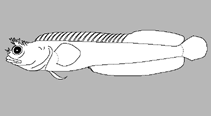
колючие лучи анального плавника: 2. Species distinguished by: large, eye-diameter sized dark blotch on side of head posterior to eye; dorsal fin consisting of spines and segmented rays; total dorsal-fin elements 29 to 40; two or more rows of teeth on each palatine bone; top of head often spiny; patch of cranial spines on nape ends anterior to supratemporal commissural pore; inner rim of posterior infraorbital bone smooth; supraorbital cirrus moderately to strongly branched, cranial spines not short and blunt. Common amongst Chaenopsids: small elongate fishes; largest species about 12 cm SL, most under 5 cm SL. Head usually with cirri or fleshy flaps on anterior nostrils, eyes, and sometimes laterally on nape; gill membranes continuous with each other across posteroventral surface of head. Each jaw with canine-like or incisor-like teeth anteriorly; teeth usually also present on vomer and often on palatines (roof of mouth). Dorsal-fin spines flexible, usually outnumbering the segmented soft rays (numbering 7 to 37), spinous and segmented-rayed portions forming a single, continuous fin; 2 flexible spines in anal fin; pelvic fins inserted anterior to position of pectoral fins, with 1 spine not visible externally and only 2 or 3 segmented (soft) rays; all fin rays, including caudal-fin rays, unbranched (simple). Lateral line absent. Scales absent (Ref.52855).
Body shape (shape guide): elongated.
Oviparous (Ref. 56066). Eggs are attached to the walls of the parent's shelter and are brooded by the male parent (Ref. 56066).
Жизненный цикл и брачное поведение
половая зрелость | размножение | нерест | икра | Плодовитость | личинки
Oviparous (Ref. 56066). Males guard the eggs until they hatch (Ref. 56066). Also Ref. 101194.
Acero, A.P., 1985. Zoogeographical implications of the distribution of selected families of Caribbean coral reef fishes. Proc. of the Fifth International Coral Reef Congress, Tahiti, Vol. 5. (Ref. 26280)
Статус Красного Списка МСОП (Ref. 130435: Version 2025-2 (Global))
Угроза для людей
Harmless
Использование человеком
дополнительная информация
инструменты
Специальные отчеты
Скачать в формате XML
ресурсы в Интернет
Оценки, основанные на моделях
Индекс филогенетического разнообразия (ссылка
82804): PD
50 = 0.5000 [Uniqueness, from 0.5 = low to 2.0 = high].
Bayesian length-weight: a=0.00525 (0.00224 - 0.01232), b=3.07 (2.86 - 3.28), in cm total length, based on LWR estimates for this (Sub)family-body shape (Ref.
93245).
Трофический уровень (ссылка
69278): 3.4 ±0.4 se; based on size and trophs of closest relatives
Уязвимость рыбной ловли (Ref.
59153): Low vulnerability (10 of 100).
🛈