>
Blenniiformes (Blennies) >
Chaenopsidae (Pike-, tube- and flagblennies)
Etymology: Acanthemblemaria: Greek, akantha = thorn + Greek, emblema, -atos, anything that is nailed, knocked in; also anything with bass or high relief (Ref. 45335).
Eponymy: Dr David Wayne Greenfield (d: 1940) is an ichthyologist, marine biologist, zoogeographer and ecologist who is now a Research Associate at the California Academy of Sciences. [...] (Ref. 128868), visit book page.
Milieu: milieu / Klimaatzone / Diepte / verspreidingsgebied
Ecologie
marien rifbewoner. Tropical; 17°N - 14°N, 90°W - 86°W (Ref. 56268)
Western Atlantic: off Belize, Honduras and Colombia (Ref. 26282). Also in Jamaica, Yucatan, Isla de Providencia (Ref. 26938).
Grootte / Gewicht / Leeftijd
Maturiteit: Lm ? range ? - ? cm
Max length : 3.6 cm SL mannelijk / geslacht onbekend; (Ref. 51458)
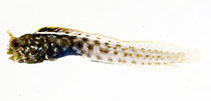
Anale stekels: 2. Species distinguished by: total dorsal-fin elements usually 39 or more; dorsal fin consisting of spines and segmented rays; several spines present on posterior third of supraorbital flange; fleshy lateral margins of interorbital region without papillae; spiny processes on head poorly developed, when present consisting of a few knobby projections; supraorbital cirrus moderately to strongly branched, cranial spines not short and blunt; patch of cranial spines on nape ends anterior to supratemporal commissural pore; inner rim of posterior infraorbital bone smooth; two or more rows of teeth on each palatine bone; top of head often spiny; no large, eye-diameter sized dark blotch on side of head posterior to eye. Common amongst Chaenopsids: small elongate fishes; largest species about 12 cm SL, most under 5 cm SL. Head usually with cirri or fleshy flaps on anterior nostrils, eyes, and sometimes laterally on nape; gill membranes continuous with each other across posteroventral surface of head. Each jaw with canine-like or incisor-like teeth anteriorly; teeth usually also present on vomer and often on palatines (roof of mouth). Dorsal-fin spines flexible, usually outnumbering the segmented soft rays (numbering 7 to 37), spinous and segmented-rayed portions forming a single, continuous fin; 2 flexible spines in anal fin; pelvic fins inserted anterior to position of pectoral fins, with 1 spine not visible externally and only 2 or 3 segmented (soft) rays; all fin rays, including caudal-fin rays, unbranched (simple). Lateral line absent. Scales absent (Ref.52855).
Body shape (shape guide): elongated.
Levenscyclus en paargedrag
Maturiteit | Voortplanting | Paaien | Eieren | Fecunditeit | Larven
Acero, A.P., 1985. Zoogeographical implications of the distribution of selected families of Caribbean coral reef fishes. Proc. of the Fifth International Coral Reef Congress, Tahiti, Vol. 5. (Ref. 26280)
Status op de Rode Lijst van het IUCN (Ref. 130435: Version 2025-2 (Global))
Gevaar voor de mens
Harmless
Gebruik door de mens
Tools
Speciale rapporten
Download XML
Internetbronnen
Schattingen op basis van modellen
Fylogenetische diversiteitsindex (Ref.
82804): PD
50 = 0.5000 [Uniqueness, from 0.5 = low to 2.0 = high].
Bayesian length-weight: a=0.00525 (0.00224 - 0.01232), b=3.07 (2.86 - 3.28), in cm total length, based on LWR estimates for this (Sub)family-body shape (Ref.
93245).
Trofisch niveau (Ref.
69278): 3.3 ±0.4 se; based on size and trophs of closest relatives
Kwetsbaarheid van de visserij (Ref.
59153): Low vulnerability (10 of 100).
🛈