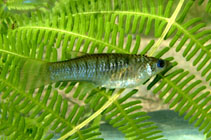
>
Cyprinodontiformes (Rivulines, killifishes and live bearers) >
Poeciliidae (Poeciliids) > Poeciliinae
Etymology: Poeciliopsis: Greek, poikilos = with a lot of colours + Greek, opsis = appearance (Ref. 45335).
More on author: Meek.
Environnement : milieu / zone climatique / profondeur / gamme de distribution
Écologie
; eau douce; saumâtre benthopélagique. Tropical; 23°C - 28°C (Ref. 2059)
Central and South America: Jalisco, Mexico to the Rio Dagua in Colombia.
Taille / Poids / Âge
Maturité: Lm ? range ? - ? cm
Max length : 4.0 cm TL mâle / non sexé; (Ref. 26130); 8.0 cm (female)
Lives in estuaries along the coast, in brooks, creeks and swift rivers, up to an elevation of 120 m. Swims at the surface or near bottom in shallow waters, over sandy or muddy substrate. Most abundant near mouth of rivers and feeds on filamentous algae, diatoms, detritus and ooze (Ref. 36880). Occasionally found with Anableps dowi.
Cycle de vie et comportement reproducteur
Maturité | Reproduction | Frai | Œufs | Fécondité | Larves
After 28 days gestation, this species gives birth to 10-50 young, rarely more.
Wischnath, L., 1993. Atlas of livebearers of the world. T.F.H. Publications, Inc., United States of America. 336 p. (Ref. 26130)
Statut dans la liste rouge de l'IUCN (Ref. 130435: Version 2025-2 (Global))
Menace pour l'homme
Harmless
Utilisations par l'homme
Outils
Articles particuliers
Télécharger en XML
Sources Internet
Estimations basées sur des modèles
Indice de diversité phylogénétique (Réf.
82804): PD
50 = 0.5000 [Uniqueness, from 0.5 = low to 2.0 = high].
Bayesian length-weight: a=0.00891 (0.00445 - 0.01786), b=3.18 (3.01 - 3.35), in cm total length, based on LWR estimates for this species & (Sub)family-body (Ref.
93245).
Niveau trophique (Réf.
69278): 2.0 ±0.00 se; based on food items.
Résilience (Réf.
120179): Haut, temps minimum de doublement de population inférieur à 15 mois (Preliminary K or Fecundity.).
Vulnérabilité de la pêche (Ref.
59153): Low vulnerability (10 of 100).
🛈