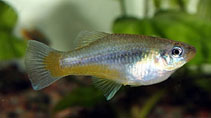
Klassifizierung / Names
Namen | Synonyme | Catalog of Fishes(Gattung, Arten) | ITIS | CoL | WoRMS | Cloffa
>
Cyprinodontiformes (Rivulines, killifishes and live bearers) >
Poeciliidae (Poeciliids) > Poeciliinae
Etymology: Priapella: Taken from Priapus, the Greek, and Roman god of procreation in the mithology and also = a phallus; diminutive (Ref. 45335).
Eponymy: This is not a true eponym as it is after Priapus, the Greek god of fertility. [...] (Ref. 128868), visit book page.
Umwelt: Milieu / Klimazone / Tiefenbereich / Verbreitungsgebiet
Ökologie
; süßwasser pelagisch; pH range: 6.8 - 7.2; dH range: 5 - 15. Tropical; 24°C - 28°C (Ref. 26130)
Central America: Rio Grijalva system to the lower Rio Usumacinta basin in Chiapas, Mexico.
Größe / Gewicht / Alter
Geschlechtsreife: Lm ? range ? - ? cm
Max length : 4.5 cm TL Männchen/unbestimmt; (Ref. 26130); 7.0 cm (female)
Adults inhabit rapidly flowing, preferably torrential waters. Usually found in shallow waters about 20 to 50 cm deep. They feed on insects. They live along with livebearing Xiphophorus alvarezi only in the Rio Palenque (Ref. 26130). Migratory behaviour is undetermined (Ref. 126106).
Lebenszyklus und Paarungsverhalten
Geschlechtsreife | Fortpflanzung | Ablaichen | Eier | Fruchtbarkeit | Larven
After 28 days of gestation, this species gives birth to 10-30 young.
Wischnath, L., 1993. Atlas of livebearers of the world. T.F.H. Publications, Inc., United States of America. 336 p. (Ref. 26130)
IUCN Rote Liste Status (Ref. 130435: Version 2025-2 (Global))
Bedrohung für Menschen
Harmless
Nutzung durch Menschen
Fischereien: kommerziell; Aquarium: Kommerziell
Tools
Zusatzinformationen
Download XML
Internet Quellen
Schätzungen auf der Grundlage von Modellen
Phylogenetischer Diversitätsindex (Ref.
82804): PD
50 = 0.5156 [Uniqueness, from 0.5 = low to 2.0 = high].
Bayesian length-weight: a=0.01047 (0.00458 - 0.02392), b=3.14 (2.96 - 3.32), in cm total length, based on LWR estimates for this (Sub)family-body shape (Ref.
93245).
Trophische Ebene (Ref.
69278): 3.2 ±0.40 se; based on food items.
Widerstandsfähigkeit (Ref.
120179): hoch, Verdopplung der Population dauert weniger als 15 Monate. (Preliminary K or Fecundity.).
Anfälligkeit der Fischerei (Ref.
59153): Low vulnerability (10 of 100).
🛈