Klassifizierung / Names
Namen | Synonyme | Catalog of Fishes(Gattung, Arten) | ITIS | CoL | WoRMS | Cloffa
>
Cyprinodontiformes (Rivulines, killifishes and live bearers) >
Poeciliidae (Poeciliids) > Poeciliinae
Etymology: Xenophallus: Greek, xenos = strange + Latin, phallus = penis (Ref. 45335).
More on author: Meek.
Umwelt: Milieu / Klimazone / Tiefenbereich / Verbreitungsgebiet
Ökologie
; süßwasser pelagisch; pH range: ? - 7.2; dH range: ? - 3; tiefenbereich 10 - 20 m (Ref. 36880). Tropical; 21°C - 37°C (Ref. 36880)
Central America: Lake Nicaragua on the Atlantic drainage to the Río Parismina and the Río Tenorio drainage on the Pacific slope (Ref. 36880). Costa Rica and Nicaragua.
Größe / Gewicht / Alter
Geschlechtsreife: Lm ? range ? - ? cm
Max length : 4.5 cm SL Männchen/unbestimmt; (Ref. 36880)
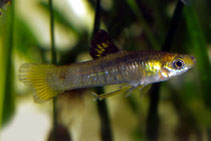
Body thin, translucent and yellowish. Base of the first dorsal rays with a black blotch; in males the posterior edge of the dorsal fin is also black and sometimes the remainder of the fin is brilliant yellow. The males and young have 5 to 10 black bars on the side which are diffuse or absent in females. The gonopodium is asymmetrical and either dextral or sinistral; the apex of which in mature males bears a long upper projection and swelling below, both of which are membranous (Ref. 36880).
Body shape (shape guide): elongated; Cross section: oval.
Inhabits waters of all velocities, between 35 and 590 m elevation, with temperatures of 21 to 37°C. Lives in small groups in brooks, creeks and along the shorelines of rivers where it feeds on detritus, filamentous algae, aquatic insects and ooze. Probably reproduces throughout the year (Ref. 36880).
Lebenszyklus und Paarungsverhalten
Geschlechtsreife | Fortpflanzung | Ablaichen | Eier | Fruchtbarkeit | Larven
After 28 days gestation, about 15 to 50 young are born. Sexual maturity is reached after 3-4 months (Ref. 2060).
Lucinda, P.H.F., 2003. Poeciliidae (Livebearers). p. 555-581. In R.E. Reis, S.O. Kullander and C.J. Ferraris, Jr. (eds.) Checklist of the Freshwater Fishes of South and Central America. Porto Alegre: EDIPUCRS, Brazil. (Ref. 50894)
IUCN Rote Liste Status (Ref. 130435: Version 2025-2 (Global))
Bedrohung für Menschen
Harmless
Nutzung durch Menschen
Tools
Zusatzinformationen
Download XML
Internet Quellen
Schätzungen auf der Grundlage von Modellen
Phylogenetischer Diversitätsindex (Ref.
82804): PD
50 = 1.0000 [Uniqueness, from 0.5 = low to 2.0 = high].
Bayesian length-weight: a=0.00851 (0.00369 - 0.01962), b=3.15 (2.96 - 3.34), in cm total length, based on LWR estimates for this (Sub)family-body shape (Ref.
93245).
Trophische Ebene (Ref.
69278): 2.4 ±0.21 se; based on food items.
Widerstandsfähigkeit (Ref.
120179): hoch, Verdopplung der Population dauert weniger als 15 Monate. (Preliminary K or Fecundity.).
Anfälligkeit der Fischerei (Ref.
59153): Low vulnerability (10 of 100).
🛈