Elasmobranchi (squali e razze) (sharks and rays) >
Torpediniformes (Electric rays) >
Narkidae (Sleeper rays)
Etymology: Typhlonarke: Greek, typhlops = blind + Greek, narke = numbness (Ref. 45335).
Eponymy: Lake Falconer Ayson (1855–1927) gave the holotype to its describer after the vessel ‘Doto’ trawled it up on a research cruise, of which Ayson was the leader. [...] (Ref. 128868), visit book page.
Ambiente: milieu / zona climatica / distribuzione batimetrica / gamma di distribuzione
Ecologia
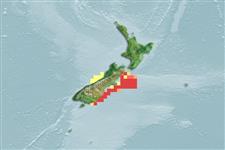
marino batidemersale; distribuzione batimetrica 65 - 900 m (Ref. 26346), usually 300 - 400 m (Ref. 114953). Deep-water; 42°S - 47°S, 169°E - 176°E (Ref. 114953)
Southwest Pacific: endemic to New Zealand.
Dimensione / Peso / Età
Maturità: Lm ? range ? - ? cm
Max length : 45.0 cm TL maschio/sesso non determinato; (Ref. 114953)
Breve descrizione
Chiavi di identificazione | Morfologia | Morfometria
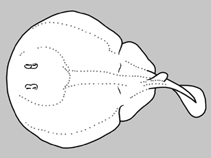
Spine anali: 0. Dark brown dorsally, light brown ventrally (Ref. 26346).
Body shape (shape guide): other.
Found on the continental shelf and slope (Ref. 26346). Produces up to 11 pups a litter. Males reaches maturity at 35-40 cm TL; birth size at 9-10 cm TL (Ref. 114953).
Ciclo vitale e comportamento di accoppiamento
Maturità | Riproduzione | Deposizione | Uova | Fecondità | Larve
Presumably ovoviviparous, with up to 11 young born at 9-10 cm (Ref. 26346).
Cox, G. and M. Francis, 1997. Sharks and rays of New Zealand. Canterbury Univ. Press, Univ. of Canterbury. 68 p. (Ref. 26346)
Stato della Lista Rossa IUCN (Ref. 130435: Version 2025-2 (Global))
Minaccia per l'uomo
Harmless
Usi umani
Strumenti
Rapporti speciali
Scarica XML
Fonti Internet
Stime basate su modelli
Indice di diversità filogenetica (Fonte Biblio.
82804): PD
50 = 0.7502 [Uniqueness, from 0.5 = low to 2.0 = high].
Bayesian length-weight: a=0.01000 (0.00244 - 0.04107), b=3.04 (2.81 - 3.27), in cm total length, based on all LWR estimates for this body shape (Ref.
93245).
Livello trofico (Fonte Biblio.
69278): 3.3 ±0.3 se; based on size and trophs of closest relatives
Resilienza (Fonte Biblio.
120179): Basso, tempo minimo di raddoppiamento della popolazione 4.5 - 14 anni (Assuming fecundity<100).
Vulnerabilità della pesca (Ref.
59153): Low to moderate vulnerability (35 of 100).
🛈