>
Cypriniformes (Carps) >
Tanichthyidae (Mountain minnows)
Etymology: Tanichthys: Named for Mr Tan Kam Fei, the famous Scout of Kwangtung; for his interest in ichthyology and encouraging the young scouts toward the study of nature.
Eponymy: Tan Kam Fei was a Chinese boy-scout leader who discovered and collected the first specimens of the minnows (1932) and brought them to the attention of the author. (Ref. 128868), visit book page.
Umwelt: Milieu / Klimazone / Tiefenbereich / Verbreitungsgebiet
Ökologie
; süßwasser demersal; pH range: 6.0 - 8.0; dH range: 5 - 19. Tropical; 18°C - 22°C (Ref. 1672); 24°N - 18°N, 104°E - 121°E (Ref. 85799)
Asia: China (Ref. 1739) and Viet Nam (Ref. 44416). Thought to be extinct in the wild (Ref. 89952). Introduced elsewhere.
Größe / Gewicht / Alter
Geschlechtsreife: Lm ? range ? - ? cm
Max length : 4.0 cm TL Männchen/unbestimmt; (Ref. 5258); common length : 2.1 cm SL Männchen/unbestimmt; (Ref. 35840)
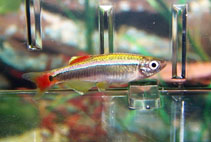
Rückenflossenstacheln (insgesamt) : 2 - 3; Rückenflossenweichstrahlen (insgesamt) : 6 - 7; Afterflossenstacheln: 3; Afterflossenweichstrahlen: 7 - 9. Body green, with golden vertical zones on central axis of body and a number of dark lines above zones; dorsal and anal fins green and transparent edge; base of caudal fin with large red round spots. Snout blunt; lip thin and lower jaw a bit protruded; barbel absent; dorsal fin short and opposite anal fin, pectoral and pelvic fins small; pelvic scute absent (Ref. 45563).
Body shape (shape guide): fusiform / normal; Cross section: compressed.
Adults are found in clean, sluggish coastal stream amongst hydrophytes (Ref. 85799). They can survive in water temperature as low as 5°C. They feed on zooplankton and detritus. Migratory behaviour is undetermined (Ref. 126106). Aquarium keeping: in groups of 5 or more individuals; minimum aquarium size 60 cm (Ref. 51539).
Lebenszyklus und Paarungsverhalten
Geschlechtsreife | Fortpflanzung | Ablaichen | Eier | Fruchtbarkeit | Larven
Kottelat, M., 2001. Freshwater fishes of northern Vietnam. A preliminary check-list of the fishes known or expected to occur in northern Vietnam with comments on systematics and nomenclature. Environment and Social Development Unit, East Asia and Pacific Region. The World Bank. 123 p. (Ref. 44416)
IUCN Rote Liste Status (Ref. 130435: Version 2025-2 (Global))
Bedrohung für Menschen
Harmless
Nutzung durch Menschen
Fischereien: hoch kommerziell; Aquarium: hoch kommerziell
Tools
Zusatzinformationen
Download XML
Internet Quellen
Schätzungen auf der Grundlage von Modellen
Phylogenetischer Diversitätsindex (Ref.
82804): PD
50 = 0.5312 [Uniqueness, from 0.5 = low to 2.0 = high].
Bayesian length-weight: a=0.01023 (0.00397 - 0.02640), b=3.08 (2.86 - 3.30), in cm total length, based on LWR estimates for this (Sub)family-body shape (Ref.
93245).
Trophische Ebene (Ref.
69278): 2.7 ±0.31 se; based on food items.
Widerstandsfähigkeit (Ref.
120179): hoch, Verdopplung der Population dauert weniger als 15 Monate. (tm<1).
Anfälligkeit der Fischerei (Ref.
59153): Low vulnerability (10 of 100).
🛈