Ambiente: milieu / zona climatica / distribuzione batimetrica / gamma di distribuzione
Ecologia
; acqua dolce; salmastro pelagico; pH range: 6.0 - 8.0; dH range: 5 - 19. Tropical; 16°C - 26°C (Ref. 1672); 30°N - 20°N, 102°E - 122°E
Asia: China, from Yangtze basin to the south, on Hainan Island, in Taiwan, north Viet Nam; introduced to the tropical and subtropical world (Ref. 42924). Very popular with aquarists and has been widely transported around the world.
Dimensione / Peso / Età
Maturità: Lm ? range ? - ? cm
Max length : 6.7 cm SL maschio/sesso non determinato; (Ref. 43281); common length : 5.5 cm TL maschio/sesso non determinato; (Ref. 12193); peso massimo pubblicato: 5.12 g (Ref. 132332)
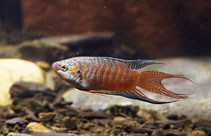
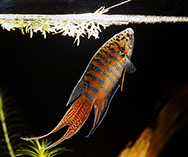
Spine dorsali (totale) : 11 - 17; Raggi dorsali molli (totale) : 5 - 10; Spine anali: 7 - 22; Raggi anali molli: 9 - 15; Vertebre: 27 - 29. Caudal fin forked, both lobes elongate in males (Ref. 559), with filamentous extension in each lobe (Ref. 43281); lower margin of preorbital sharply serrated (Ref. 559); conspicuous dark brown opercular spot with whitish posterior margin (margin red in life); body with 7-11 bold, dark bars on pale yellowish background in preserved specimens (blue bars on reddish background in life); dark stripe crossing eye connecting opercular spot with eye; top of head and predorsal body with dark spots; posterior tip or margin of scales on body not darker than scales (Ref. 42924).
Body shape (shape guide): short and / or deep; Cross section: compressed.
Obligate air-breathing (Ref. 126274); Adults inhabit any kind of lowland habitats from heterogeneous structured margins or backwaters of large rivers to small streams and irrigation channels on farmland (Ref. 42924). Can colonize stagnant water bodies with very low oxygen content (air breather). Found in streams, paddy fields and ditches (Ref. 5258). Feed on small aquatic animals including small fish. First ornamental fish to be brought to Europe (France 1869, Germany 1876) after the goldfish (Ref. 13371). Males will fight each other (Ref. 1672). Aquarium keeping: minimum aquarium size 80 cm (Ref. 51539).
Ciclo vitale e comportamento di accoppiamento
Maturità | Riproduzione | Deposizione | Uova | Fecondità | Larve
The species is a bubble-nest builder; the male swims to the surface, draws a little air into his mouth and envelops it in a film of saliva thereby forming bubbles; upon building the nest, the male drives the female towards it; female spawns then male follows; male picks up the fertilized eggs in his mouth and pushes one by one into each bubble of the nest; male guards eggs until hatching (Ref. 5258). Produces up to 500 eggs (Ref. 1672).
Freyhof, J. and F. Herder, 2002. Review of the paradise fishes of the genus Macropodus in Vietnam, with description of two species from Vietnam and southern China (Perciformes: Osphronemidae). Ichthyol. Explor. Freshwat. 13(2):147-167. (Ref. 42924)
Stato della Lista Rossa IUCN (Ref. 130435: Version 2025-2 (Global))
Minaccia per l'uomo
Harmless
Usi umani
Pesca: di nessun interesse; Acquario: Commerciale
Strumenti
Rapporti speciali
Scarica XML
Fonti Internet
Stime basate su modelli
Indice di diversità filogenetica (Fonte Biblio.
82804): PD
50 = 0.5020 [Uniqueness, from 0.5 = low to 2.0 = high].
Bayesian length-weight: a=0.01288 (0.00688 - 0.02412), b=2.97 (2.80 - 3.14), in cm total length, based on LWR estimates for this species & (Sub)family-body (Ref.
93245).
Livello trofico (Fonte Biblio.
69278): 3.8 ±0.55 se; based on food items.
Resilienza (Fonte Biblio.
120179): Alto, tempo minimo di raddoppiamento della popolazione meno di 15 mesi (tm<1; Fec=100-500 times 6-12 spawning events).
Vulnerabilità della pesca (Ref.
59153): Low vulnerability (10 of 100).
🛈