>
Cichliformes (Cichlids, convict blennies) >
Cichlidae (Cichlids) > Cichlasomatinae
Etymology: Amphilophus: Greek, amphi = on both sides + Greek, lophos = crest (Ref. 45335).
More on author: Günther.
Entorno: milieu / zona climática / rango de profundidad / gama de distribución
Ecología
; agua dulce bentopelágico; no migratorio (Ref. 126106). Tropical; 23°C - 33°C (Ref. 7335); 15°N - 8°N
Central America: Atlantic slope of Nicaragua and Costa Rica (San Juan River drainage, including Lakes Nicaragua, Managua, Masaya and Apoyo).
Tamaño / Peso / Edad
Madurez: Lm ? range ? - ? cm
Max length : 24.4 cm SL macho / no sexado; (Ref. 36377)
Descripción breve
Claves de identificación | Morfología | Morfometría
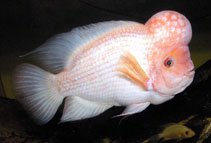
This species coloration is mostly bright orange to orange-red in adults; mature males are of larger size, longer fins and with a distinct hump on their heads; aquarists usually refer to the lighter-colored, thin-lipped form as this species.
Body shape (shape guide): short and / or deep.
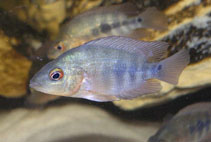
Adults livesin box-cut canals with rocky vertical sides, crevices used for spawning and protection of the young (Ref. 5723). They are found in lakes; uncommon in the rivers but will penetrate the lower river valleys where the water is slow flowing or tranquil (Ref. 7335). Omnivorous, eating mostly aufwuchs, snails and small fishes (Ref. 7335); also feed on insect larvae, worms and other bottom-dwelling organisms (Ref. 44091). Majority of this fish has normal cryptic coloration (black, gray or brown), matching the substrate for camouflage and survival purposes. About 10 % of this species is xanthomorphic, undergoing a color metamorphosis at varying stages of growth (Ref. 7335). An experimental fish being used for behavioral studies (Ref. 4537).
Ciclo vital y comportamiento de apareamiento
Madurez | Reproducción | Puesta | Huevos | Fecundidad | Larva
Spawn preferentially on the ceiling of natural caves (Ref. 38966). Deposit eggs on hard substrates, such as rocks or logs; both parents guarding the eggs and the fry for several weeks (Ref. 44091). 300-1000 eggs (Ref. 2060).
Kullander, S.O., 2003. Cichlidae (Cichlids). p. 605-654. In R.E. Reis, S.O. Kullander and C.J. Ferraris, Jr. (eds.) Checklist of the Freshwater Fishes of South and Central America. Porto Alegre: EDIPUCRS, Brasil. (Ref. 36377)
Situación en la Lista Roja de la UICN (Ref. 130435: Version 2025-2 (Global))
Amenaza para el ser humano
Harmless
Usos humanos
Pesquerías: sin interés; pesca deportiva: si; Acuario: Comercial
Herramientas
Informes especiales
Descargar XML
Fuentes de Internet
Estimaciones basadas en modelos
Índice de diversidad filogenética (Referencia
82804): PD
50 = 0.5000 [Uniqueness, from 0.5 = low to 2.0 = high].
Bayesian length-weight: a=0.02692 (0.01211 - 0.05983), b=3.02 (2.83 - 3.21), in cm total length, based on LWR estimates for this (Sub)family-body shape (Ref.
93245).
Nivel trófico (Referencia
69278): 3.2 ±0.47 se; based on food items.
Resiliencia (Referencia
120179): Medio, población duplicada en un tiempo mínimo de 1.4-4.4 años (Fec=300-1,000).
Vulnerabilidad pesquera (Ref.
59153): Low vulnerability (20 of 100).
🛈