>
Anabantiformes (Gouramies, snakeheads) >
Channidae (Snakeheads)
Etymology: Channa: Greek, channe, -es = an anchovy (Ref. 45335).
Eponymy: Argus (or Argos) was a 100–eyed watchman in Greek mythology. [...] (Ref. 128868), visit book page.
Environnement : milieu / zone climatique / profondeur / gamme de distribution
Écologie
; eau douce benthopélagique; non migrateur (Ref. 126106). Subtropical; 4°C - 22°C (Ref. 2060); 54°N - 25°N, 111°E - 141°E
Asia: Amur southward to Xi Jiang and Hainan Island, China (Ref. 82587). Introduced elsewhere. Japan (Ref. 6094) and the USA (Ref. 51238) report adverse ecological impact after introduction.
Longueur à la première maturité / Taille / Poids / Âge
Maturité: Lm 30.0 range ? - ? cm
Max length : 100.0 cm TL mâle / non sexé; (Ref. 56557); poids max. publié: 8.0 kg (Ref. 56557)
Description synthétique
Clés d'identification | Morphologie | Morphométrie
Épines dorsales (Total) : 0; Rayons mous dorsaux (Total) : 49 - 54; Épines anales: 0; Rayons mous anaux: 32 - 38.
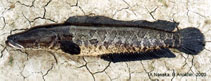
Body shape (shape guide): elongated.
Obligate air-breathing (Ref. 126274); Individuals can stay out of the water for 3 to 4 days at temperatures ranging from 10 to 15°C (Ref. 37350). They are typical ambush predators that lie waiting for prey on the bottom. They hunt mainly in the morning and in the evening, feeding primarily on fish (Ref. 12569). They mature at the age of 2 years and length of 30 cm. Spawning takes place in June and July (Ref. 56557). Eggs are pelagic. Utilized for human consumption.
Cycle de vie et comportement reproducteur
Maturité | Reproduction | Frai | Œufs | Fécondité | Larves
Bogutskaya, N.G., A.M. Naseka, S.V. Shedko, E.D. Vasil'eva and I.A. Chereshnev, 2008. The fishes of the Amur River: updated check-list and zoogeography. Ichthyol. Explor. Freshwat. 19(4):301-366. (Ref. 82587)
Statut dans la liste rouge de l'IUCN (Ref. 130435: Version 2025-2 (Global))
Menace pour l'homme
Potential pest (Ref. 45309)
Utilisations par l'homme
Pêcheries: commercial; Aquaculture: commercial; pêche sportive: oui; Aquarium: Aquariums publics
Outils
Articles particuliers
Télécharger en XML
Sources Internet
Estimations basées sur des modèles
Indice de diversité phylogénétique (Réf.
82804): PD
50 = 0.5000 [Uniqueness, from 0.5 = low to 2.0 = high].
Bayesian length-weight: a=0.00741 (0.00487 - 0.01128), b=3.01 (2.89 - 3.13), in cm total length, based on LWR estimates for this species & Genus-body shape (Ref.
93245).
Niveau trophique (Réf.
69278): 4.4 ±0.3 se; based on diet studies.
Generation time: 8.5 ( na - na) years. Estimated as median ln(3)/K based on 2
growth studies.
Résilience (Réf.
120179): Faible, temps minimum de doublement de population : 4,5 à 14 années (Preliminary K or Fecundity.).
Vulnérabilité de la pêche (Ref.
59153): High vulnerability (62 of 100).
🛈