>
Blenniiformes (Blennies) >
Blenniidae (Combtooth blennies) > Salariinae
Etymology: Parablennius: Greek, para = the side of + Greek, blennios = mucus (Ref. 45335).
More on author: Linnaeus.
Окружающая среда: среда / климатическая зона / пределы глубины / диапазон распространения
экология
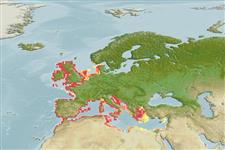
морской демерсальный; немигрирующий; пределы глубины 3 - 32 m (Ref. 5981). Subtropical; 59°N - 31°N, 11°W - 35°E
Northeast Atlantic: Atlantic coast from Ireland to Morocco; also in the Mediterranean Sea and the Sea of Marmora. This species is present only in mainland Portugal (Ref. 13612). Although older papers reported this species from the Azores and Madeira, it has been concluded that the occurrences were misidentifications of Parablennius ruber (Ref. 13612).
Размер / Вес / Возраст
половая зрелость: Lm ? range ? - ? cm
Max length : 30.0 cm TL самец/пол неопределен; (Ref. 3397); common length : 17.5 cm TL самец/пол неопределен; (Ref. 3397)
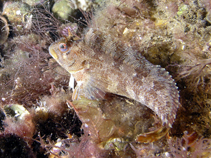
колючие лучи спинного плавника (общее число) : 13 - 14; членистые (мягкие) лучи спинного плавника (общее число) : 17 - 20; колючие лучи анального плавника: 2; членистые (мягкие) лучи анального плавника: 19 - 23. Gill membranes not forming fold across isthmus. Tentacles on nasal openings and above eyes. No canine teeth in upper jaw. Dentaries joined by ligament. Frontals not covered by parietals. Spawning males chocolate-brown, with bulb glands on spiny anal fin rays. Lateral line continuous with branches but discontinuous posteriorly.
Body shape (shape guide): fusiform / normal.
Facultative air-breathing (Ref. 126274); Active mainly during dusk and dawn (Ref. 5204). Adults live in rocky while young are found in shallow water in the seaweed zone. Oviparous (Ref. 205). Spawn in March - May. Male guards the eggs from several females, until larvae about 1 month (Ref. 35388). Eggs are demersal and adhesive (Ref. 205), and are attached to the substrate via a filamentous, adhesive pad or pedestal (Ref. 94114). Larvae are planktonic, often found in shallow, coastal waters (Ref. 94114).
Spawning males reside in holes where several females spawn. Males, thus, guard the eggs. Oviparous, distinct pairing (Ref. 205).
Wheeler, A., 1992. A list of the common and scientific names of fishes of the British Isles. J. Fish Biol. 41(suppl.A):1-37. (Ref. 5204)
Статус Красного Списка МСОП (Ref. 130435: Version 2025-2 (Global))
Угроза для людей
Harmless
Использование человеком
рыболовство: не имеет хозяйственного значения; аквариум: коммерческий
дополнительная информация
инструменты
Специальные отчеты
Скачать в формате XML
ресурсы в Интернет
Оценки, основанные на моделях
Предпочтительная температура (ссылка
123201): 9.9 - 19.8, mean 17.4 °C (based on 701 cells).
Индекс филогенетического разнообразия (ссылка
82804): PD
50 = 0.5000 [Uniqueness, from 0.5 = low to 2.0 = high].
Bayesian length-weight: a=0.01202 (0.00771 - 0.01875), b=3.04 (2.91 - 3.17), in cm total length, based on LWR estimates for this species & Genus-body shape (Ref.
93245).
Трофический уровень (ссылка
69278): 3.6 ±0.0 se; based on diet studies.
устойчивость к внешним воздействиям (ссылка
120179): высокий, минимальное время удвоения популяции до 15 месяцев (tm=1).
Уязвимость рыбной ловли (Ref.
59153): Low vulnerability (20 of 100).
🛈
Питательные вещества (Ref.
124155): Calcium = 129 [72, 243] mg/100g; Iron = 1.35 [0.86, 2.22] mg/100g; Protein = 19.3 [18.4, 20.1] %; Omega3 = 0.359 [0.237, 0.555] g/100g; Selenium = 22.3 [11.9, 42.3] μg/100g; VitaminA = 10.8 [4.0, 29.8] μg/100g; Zinc = 0.845 [0.612, 1.194] mg/100g (wet weight);