>
Siluriformes (Catfishes) >
Clariidae (Airbreathing catfishes)
Etymology: Clarias: Greek, chlaros = lively, in reference to the ability of the fish to live for a long time out of water.
More on author: Günther.
Milieu: milieu / Klimaatzone / Diepte / verspreidingsgebied
Ecologie
; zoet water; brak water benthopelagisch; potamodroom (Ref. 51243); diepte 1 - ? m (Ref. 9987). Tropical; 34°N - 4°N
Asia: Thailand to Viet Nam. Introduced to China, Malaysia, Guam and the Philippines.
Lengte bij maturiteit / Grootte / Gewicht / Leeftijd
Maturiteit: Lm ?, range 19 - ? cm
Max length : 120 cm TL mannelijk / geslacht onbekend; (Ref. 9987); max. gepubliceerd gewicht: 45.0 kg (Ref. 9987)
Korte beschrijving
Determinatiesleutels | Morfologie | Morfometrie
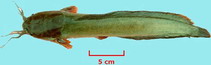
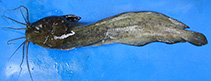
Dorsale stekels (totaal) : 0. Distinguished from Southeast Asian congeners by an extremely short and rounded occipital process and by a very high dorsal fin. The combination of these characters are diagnostic for the species (Ref. 33566). Occipital process wide, broadly curved, with length 3-5 times in its width; distance between dorsal and occipital process 5-7 times in distance from tip of snout to end of occipital process (Ref. 43281).
Body shape (shape guide): elongated.
Facultative air-breathing (Ref. 126274); Lives in lowland wetlands and rivers (Ref. 57235). Recorded as having been or being farmed in rice fields (Ref. 119549). Occurs in shallow, open water and is capable of lying buried in mud for lengthy period if ponds and lakes evaporate during dry seasons (Ref. 9987). Can move out of the water using its extended fins (Ref. 9987). Found in medium to large-sized rivers, stagnant water bodies including sluggish flowing canals and flooded fields of the Mekong (Ref. 12975). Spawns in small streams (Ref. 9987). Feeds on aquatic insects, young shrimps and small fishes (Ref. 6459). In Thailand, it was thought wrongly as female of Clarias batrachus (Ref 2686). Important foodfish and in pond cultures (Ref. 57235). Marketed live, fresh and frozen; consumed fried, broiled and baked (Ref. 9987). Cultivated on a small scale but attempts to farm it are increasing (Ref. 9987).
Eggs are attached to the roots of plants. Male takes charge of these eggs until they are hatched out.
Teugels, G.G., R.C. Diego, L. Pouyaud and M. Legendre, 1999. Redescription of Clarias macrocephalus (Siluriformes: Clariidae) from South-East Asia. Cybium 23(3):285-295. (Ref. 33566)
Status op de Rode Lijst van het IUCN (Ref. 130435: Version 2025-2 (Global))
Gevaar voor de mens
Harmless
Gebruik door de mens
Visserij: commercieel; Aquacultuur: commercieel
Tools
Speciale rapporten
Download XML
Internetbronnen
Schattingen op basis van modellen
Fylogenetische diversiteitsindex (Ref.
82804): PD
50 = 0.5000 [Uniqueness, from 0.5 = low to 2.0 = high].
Bayesian length-weight: a=0.00851 (0.00486 - 0.01489), b=2.98 (2.83 - 3.13), in cm total length, based on LWR estimates for this species & Genus-body shape (Ref.
93245).
Trofisch niveau (Ref.
69278): 3.7 ±0.58 se; based on food items.
Weerstandsvermogen (Ref.
120179): Hoog, minimale populatieverdubbelingstijd minder dan 15 maanden (Assuming tm=1; Fec=800-14,000).
Kwetsbaarheid van de visserij (Ref.
59153): High to very high vulnerability (72 of 100).
🛈
Voedingsstoffen (Ref.
124155): Calcium = 16.9 [7.6, 71.2] mg/100g; Iron = 0.76 [0.42, 1.38] mg/100g; Protein = 16.4 [15.4, 17.5] %; Omega3 = 0.114 [0.052, 0.270] g/100g; Selenium = 111 [45, 288] μg/100g; VitaminA = 16.1 [5.4, 48.7] μg/100g; Zinc = 0.565 [0.400, 0.811] mg/100g (wet weight); based on
nutrient studies.