>
Perciformes/Zoarcoidei (Eelpouts and pricklebacks) >
Zoarcidae (Eelpouts) > Lycodinae
Etymology: Argentinolycus: Named for Argentina, where the species is known mainly from the Argentine Patagonia, and the Greek 'lykos' (= wolf), a commonly used suffix for southern hemisphere zoarcid genera.
Lingkungan: lingkungan / zona iklim / kisaran kedalaman / jangkauan distribusi
Ekologi
laut dasar (demersal); kisaran kedalaman 0 - 40 m (Ref. 11954). Temperate
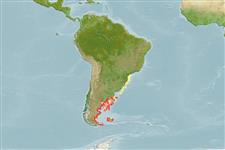
Southwest Atlantic: Puerto Madryn, Argentina to Tierra del Fuego in the south.
Ukuran / Berat / umur
Kematangan: Lm ? range ? - ? cm
Max length : 14.7 cm SL jantan/; (Ref. 11954)
deskripsi pendek
Kunci identifiaksi (pengenalan) | Morfologi | Morfometrik
This species is distinguished by the following characters: elongated and depressed neurocranium; parasphenoid wing is broad and without dorsal ramus projecting above ventral base of trigeminofacialis foramen; articulating frontal and parasphenoid; enlarged pterosphenoid; intercalar very small and set posteriorly; separate frontal bones, the frontal corner tapering; parietals meet in dorsal mid-line; small supraoccipital, with exoccipital narrowly articulating posteriorly; sphenotic excluded from parietal by frontal and pterotic; posterior ramus of hyomandibula is elongated; well developed palatopterygoid series; ectopterygoid overlap both anterior and dorsal surface of quadrate; ceratohyal-epihyal juncture with bone interdigitating along its entire length; 6 branchiostegal rays; 7-8 suborbital bones, its canal with 6 pores; no posttemporal ventral ramus; scapular foramen enclosed, scapula with well developed posterior strut; postcleithrum present; vertebrae asymmetrical, 22-24+62-69 = 84-90; well developed oral valve; gill slit extending ventrally to slightly below lower end of pectoral-fin base; absence of interorbital or occipital pores and commissure across parietals; suborbital pores along ventral ramus (6+0); nasal pores 2; only postorbital pore 4; lateral line mediolateral complete; no pyloric caeca; pelvic-fin membranes excised at tip; presence of scales, palatine and vomerine teeth (Ref. 90127).
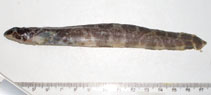
Body shape (shape guide): elongated.
Inhabits the intertidal zone to about 40 m (Ref. 11954).
Siklus hidup dan perilaku kawin
Kematangan | Reproduksi, perkembang biakan | Pemijahan | telur-telur | Fekunditas | Larva
Anderson, M.E., 1994. Systematics and osteology of the Zoarcidae (Teleostei: Perciformes). Ichthyol. Bull. J.L.B. Smith Inst. Ichthyol. 60:120 p. (Ref. 11954)
Status IUCN Red List (Ref. 130435: Version 2025-2 (Global))
ancaman kepada manusia
Harmless
penggunaan manusia
Alat, peralatan
laporan khas
muat turun XML
Sumber internet
Estimasi berdasarkan model
Indeks keanekaragaman filogenetik (Acuan
82804): PD
50 = 1.0000 [Uniqueness, from 0.5 = low to 2.0 = high].
Bayesian length-weight: a=0.00282 (0.00145 - 0.00550), b=3.20 (3.03 - 3.37), in cm total length, based on LWR estimates for this (Sub)family-body shape (Ref.
93245).
Tingkat Trofik (Acuan
69278): 3.3 ±0.4 se; based on size and trophs of closest relatives
Daya lenting (Acuan
120179): sedang, Waktu penggandaan populasi minimum 1.4 - 4.4 tahun (Preliminary K or Fecundity.).
Kerentanan Penangkapan Ikan (Ref.
59153): Low vulnerability (10 of 100).
🛈