>
Clupeiformes (Herrings) >
Alosidae (Shads and Sardines)
Etymology: Alosa: Latin, alausa = a fish cited by Ausonius and Latin, halec = pickle, dealing with the Greek word hals = salt; it is also the old Saxon name for shad = "alli" ; 1591 (Ref. 45335).
Eponymy: This is a toponym referring to Tana or Tanais, the medieval trading city on the Sea of Azov, where it occurs. (Ref. 128868), visit book page.
Lingkungan: lingkungan / zona iklim / kisaran kedalaman / jangkauan distribusi
Ekologi
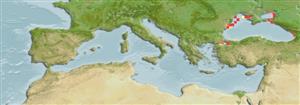
laut; air tawar; payau pelagic-neritic; anadromus (ruaya dari laut ke air tawar) (Ref. 138126); kisaran kedalaman 50 - 70 m (Ref. 59043). Temperate; 48°N - 40°N, 26°E - 44°E
Eurasia: Black Sea and Sea of Azov from where adults ascend rivers, migrating a short distance upstream to spawn.
Ukuran / Berat / umur
Kematangan: Lm ? range ? - ? cm
Max length : 30.0 cm TL jantan/; (Ref. 96734); Berat maksimum terpublikasi: 59.00 g (Ref. 593)
deskripsi pendek
Kunci identifiaksi (pengenalan) | Morfologi | Morfometrik
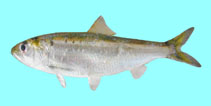
Distinguished from its congeners entering freshwater in Black Sea basins by having 66-96 gill rakers, longer than branchial filaments and poorly-developed teeth on palatine and vomer (Ref. 59043).
Body shape (shape guide): fusiform / normal.
This species migrates from sea to mouth and lower reaches of large rivers (at 1-2 years) and spawns in fresh or slightly brackish water, usually close to the shore, upper 2-4 m, in almost still water bodies as flood plains or lakes. Many individuals spawn 2-4 seasons and spawners appear along the coast in late January to March, enter rivers when temperature reaches about 10°C in late April to May, and spawns at about 15°C or beyond in May to June. Eggs are bathypelagic or sink to bottom. Spent fish migrate to estuarine and coastal lagoons or to sea near river mouths to feed and in autumn, move to sea near river mouths to overwinter. Juveniles migrate to sea or estuaries during first summer and remain there until maturity. At sea, feeds on a wide variety of zooplankton (crustaceans), insect larvae and small fish. Populations seem to have stabilized at moderate level after most have declined during the first decades of 20th century due to water pollution. In northern Black Sea, immediate impact is foreseen due to the decline in habitat quality in suitable estuarine ecosystems. On the other hand, the species is still abundant in Azov Sea basin (Ref. 59043).
Juveniles migrate to sea or estuaries during their first summer, remaining there until they mature. After 1-2 years, they migrate upriver to breed. Spawners appear along the coast in late January-March, enter rivers when temperature reaches about 10°C, in late April and May. Spawning occurs from May to June on or above 15°C. Spent individuals migrate to estuaries and coastal lagoons or to sea near river mouths to feed. In autumn, they move to the sea to overwinter (Ref. 59043).
Berg, L.S., 1962. Freshwater fishes of the U.S.S.R. and adjacent countries. volume 1, 4th edition. Israel Program for Scientific Translations Ltd, Jerusalem. (Russian version published 1948). (Ref. 593)
Status IUCN Red List (Ref. 130435: Version 2025-2 (Global))
ancaman kepada manusia
Harmless
penggunaan manusia
Perikanan: komersial
Alat, peralatan
laporan khas
muat turun XML
Sumber internet
Estimasi berdasarkan model
Suhu yang disukai (Acuan
123201): 7.6 - 12, mean 7.6 °C (based on 6 cells).
Indeks keanekaragaman filogenetik (Acuan
82804): PD
50 = 0.5000 [Uniqueness, from 0.5 = low to 2.0 = high].
Bayesian length-weight: a=0.00646 (0.00436 - 0.00957), b=3.11 (2.99 - 3.23), in cm total length, based on LWR estimates for this species & Genus-body shape (Ref.
93245).
Tingkat Trofik (Acuan
69278): 3.7 ±0.4 se; based on size and trophs of closest relatives
Daya lenting (Acuan
120179): sedang, Waktu penggandaan populasi minimum 1.4 - 4.4 tahun (Preliminary K or Fecundity.).
Kerentanan Penangkapan Ikan (Ref.
59153): Low vulnerability (20 of 100).
🛈