Lycodes terraenovae

You can sponsor this page

Lycodes terraenovae Collett, 1896

Beobachtung melden im Fish Watcher
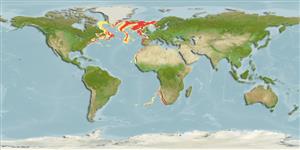
Native range
This map was computer-generated and has not yet been reviewed.
Lycodes terraenovae   AquaMaps   Data sources: GBIF OBIS
Hochladen Photos und videos
Bilder | Google Bild
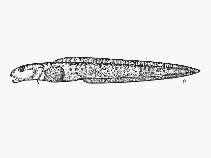
Image of Lycodes terraenovae
Lycodes terraenovae
Photo von SFSA

Klassifizierung / Names Namen | Synonyme | Catalog of Fishes(Gattung, Arten) | ITIS | CoL | WoRMS | Cloffa

> Perciformes/Zoarcoidei (Eelpouts and pricklebacks) > Zoarcidae (Eelpouts) > Lycodinae
Etymology: Lycodes: Greek, lykos = wolf + Greek, suffix, oides = similar to (Ref. 45335).

Umwelt: Milieu / Klimazone / Tiefenbereich / Verbreitungsgebiet Ökologie

seewasser bathydemersal; tiefenbereich 150 - 2604 m (Ref. 58018). Deep-water; 65°N - 36°S, 77°W - 19°E (Ref. 117245)

Verbreitung Territorien | FAO Gebiete | Ökosysteme | Vorkommen | Punkt Karte | Einführungen | Faunafri

Western Atlantic: Davis Strait, off Newfoundland and Middle Atlantic Bight. Eastern Atlantic: Rockall Trough/ Bill Bailey Bank, off Mauritania and off southwestern Africa.

Größe / Gewicht / Alter

Geschlechtsreife: Lm ?  range ? - ? cm
Max length : 45.2 cm TL Männchen/unbestimmt; (Ref. 6950)

Kurzbeschreibung Bestimmungsschlüssel | Morphologie | Morphometrie

Rückenflossenweichstrahlen (insgesamt) : 15 - 17. Body uniformly brown with dark fins. Head pores unreduced. Lateral line system with dorsolateral, a mediolateral and a ventral lateral line. Long tail, preanal 33.5-45.9% SL. Body scaled, including neck, fins and abdomen (Ref. 27255). Differs from sympatric species L. vahlii and L. esmarkii by its uniform coloration (vs. bars or marks present), lack of predorsal lateral line, smaller and fewer palatine teeth (3-5 vs. 8-22 and 5-13 respectively) and position of the last precaudal vertebrae in relation to dorsal fin (ray number 15-17 vs.18-19 and 19-20 respectively) (Ref. 36375).
Body shape (shape guide): eel-like; Cross section: oval.

Biologie     Fachlexikon (Englisch) (z.B. epibenthic)

Benthic; feeds on sponge remains, worms, molluscs, pycnogonids, crustaceans and brittle stars (Ref. 58426). Species forgotten in CLOFNAM (10007) and FNAM (4695).

Lebenszyklus und Paarungsverhalten Geschlechtsreife | Fortpflanzung | Ablaichen | Eier | Fruchtbarkeit | Larven

Hauptreferenz Laden Sie Ihre Referenzen hoch | Referenzen | Koordinator | Partner

Anderson, M.E., 1994. Systematics and osteology of the Zoarcidae (Teleostei: Perciformes). Ichthyol. Bull. J.L.B. Smith Inst. Ichthyol. 60:120 p. (Ref. 11954)

IUCN Rote Liste Status (Ref. 130435: Version 2025-2 (Global))


CITES

Not Evaluated

CMS (Ref. 116361)

Not Evaluated

Bedrohung für Menschen

  Harmless


Nutzung durch Menschen

FAO - Publication: search | FishSource |

Mehr Information

Trophische Ökologie
Lebensmittel (Beutetiere)
Nahrungszusammensetzung
Nahrungsaufnahme
Lebensmittelrationen
Räuber
Ökologie
Ökologie
Populationsdynamik
Wachstumsparameter
Max. Alter/Größen
Länge-Gewicht-Rel.
Länge-Länge-Verhältnis.
Längenhäufigkeiten
Massenkonvertierung
Rekrutierung
Dichte
Lebenszyklus
Fortpflanzung
Geschlechtsreife
Reifung/Kiemen rel.
Fruchtbarkeit
Ablaichen
Laichaggregationen
Eier
Eientwicklung
Larven
Larven Pop.Dyn.
Verbreitung
Territorien
FAO Gebiete
Ökosysteme
Vorkommen
Einführungen
BRUVS - Videos
Anatomie
Kiemenoberfläche
Gehirn
Otolith
Physiologie
Körperliche Zusammensetzung
Nährstoffe
Sauerstoffverbrauch
Schwimmart
Schwimmgeschwindigkeit
Visuelle Pigmente
Fischgeräusche
Krankheiten und Parasiten
Toxizität (LC50s)
Genetik
Genom
Genetik
Heterozygotie
Vererbbarkeit
Genetische Vielfalt
Menschenbezogen
Aquakultur-Systeme
Aquakultur Profile
Zuchtlinien
Ciguatera-Fälle
Briefmarken, Münzen, Verschiedenes.
Aufsuchen
Partner
Referenzen
Referenzen

Tools

Zusatzinformationen

Download XML

Internet Quellen

AFORO (otoliths) | Aquatic Commons | BHL | Cloffa | Websites from users | FishWatcher Einträge suchen | CISTI | Catalog of Fishes: Gattung, Arten | DiscoverLife | ECOTOX | FAO - Publication: search | Faunafri | Fishipedia | Fishtrace | GloBI | Google Books | Google Scholar | Google | IGFA World Record | OneZoom | Open Tree of Life | Otolith Atlas of Taiwan Fishes | PubMed | Reef Life Survey | Socotra Atlas | TreeBase | Tree of Life | Wikipedia: Gehe zu, Suchen | World Records Freshwater Fishing | Zoobank | Zoologischer Rekord

Schätzungen auf der Grundlage von Modellen

Bevorzugte Temperatur (Ref. 123201): 3.1 - 7.1, mean 4.1 °C (based on 329 cells).
Phylogenetischer Diversitätsindex (Ref. 82804):  PD50 = 0.5000   [Uniqueness, from 0.5 = low to 2.0 = high].
Bayesian length-weight: a=0.00182 (0.00104 - 0.00318), b=3.20 (3.04 - 3.36), in cm total length, based on LWR estimates for this species & (Sub)family-body (Ref. 93245).
Trophische Ebene (Ref. 69278):  3.5   ±0.45 se; based on food items.
Widerstandsfähigkeit (Ref. 120179):  sehr niedrig, Verdopplung der Population dauert mehr als 14 Jahre. (Preliminary K or Fecundity.).
Anfälligkeit der Fischerei (Ref. 59153):  Moderate vulnerability (35 of 100). 🛈