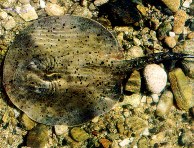
Élasmobranches (requins et raies) (sharks and rays) >
Myliobatiformes (Stingrays) >
Potamotrygonidae (River stingrays) > Potamotrygoninae
Etymology: Potamotrygon: Greek, potamos = river + Greek, trygon = a sting ray (Ref. 45335).
Eponymy: Dr Augustín Antonio Fernández-Yépez (1916–1977) was a Venezuelan architect and ichthyologist who was a curator at the Museo de Ciencias Naturales de Caracas. [...] (Ref. 128868), visit book page.
Taxonomic Remarks
Reproductive biology unknown. Additional references: Schultz (1949, as Potamotrygon magdalenae), Thorson et al. (1983a), Compagno & Cook (1995).
Environnement : milieu / zone climatique / profondeur / gamme de distribution
Écologie
; eau douce benthopélagique. Tropical
South America: Rivers draining into Maracaibo Lake.
Taille / Poids / Âge
Maturité: Lm ? range ? - ? cm
Max length : 40.0 cm WD mâle / non sexé; (Ref. 26543)
Description synthétique
Clés d'identification | Morphologie | Morphométrie
Prefers shallow muddy bottoms with turbid waters (Ref. 26543). Feeds on insect larvae (Ref. 26543).
Cycle de vie et comportement reproducteur
Maturité | Reproduction | Frai | Œufs | Fécondité | Larves
de Carvalho, M.R., N. Lovejoy and R.S. Rosa, 2003. Potamotrygonidae (River stingrays). p. 22-28. In R.E. Reis, S.O. Kullander and C.J. Ferraris, Jr. (eds.) Checklist of the Freshwater Fishes of South and Central America. Porto Alegre: EDIPUCRS, Brasil. (Ref. 36687)
Statut dans la liste rouge de l'IUCN (Ref. 130435: Version 2025-2 (Global))
Menace pour l'homme
Harmless
Utilisations par l'homme
Outils
Articles particuliers
Télécharger en XML
Sources Internet
Estimations basées sur des modèles
Indice de diversité phylogénétique (Réf.
82804): PD
50 = 0.5000 [Uniqueness, from 0.5 = low to 2.0 = high].
Bayesian length-weight: a=0.01000 (0.00244 - 0.04107), b=3.04 (2.81 - 3.27), in cm total length, based on all LWR estimates for this body shape (Ref.
93245).
Niveau trophique (Réf.
69278): 3.2 ±0.40 se; based on food items.
Résilience (Réf.
120179): Très faible, temps minimum de doublement de population supérieur à 14 ans (Assuming Fec<10).
Vulnérabilité de la pêche (Ref.
59153): High vulnerability (58 of 100).
🛈