>
Eupercaria/misc (Various families in series Eupercaria) >
Labridae (Wrasses) > Julidinae
Etymology: Halichoeres: Greek, als, alis = salt + Greek, choiros = pig (Ref. 45335).
More on author: Bleeker.
Umwelt: Milieu / Klimazone / Tiefenbereich / Verbreitungsgebiet
Ökologie
seewasser riff-verbunden; tiefenbereich 2 - 40 m (Ref. 9710). Tropical; 30°N - 24°S
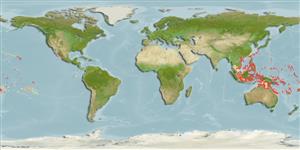
Western Pacific: east to Samoa (Ref. 27362) and Tonga (Ref. 53797).
Größe / Gewicht / Alter
Geschlechtsreife: Lm ? range ? - ? cm
Max length : 13.0 cm SL Männchen/unbestimmt; (Ref. 9823)
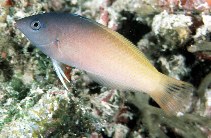
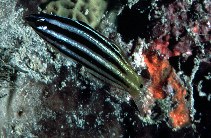
Rückenflossenstacheln (insgesamt) : 9; Rückenflossenweichstrahlen (insgesamt) : 12 - 13; Afterflossenstacheln: 3; Afterflossenweichstrahlen: 12; Wirbelzahl: 25. Anterior head and body color of adults in life bluish gray, shading posteriorly to yellowish; scales often with orange-yellow vertical lines; a dark spot posterior to dorsal half of eye; dorsal fin with a large black spot edged with blue. Anterior lateral line scales with 1-3 pores; 9-11 suborbital pores. Anterior dorsal and anal soft rays longer than posterior rays; pelvic fins of males and large females very long, reaching posterior to anus, often to or beyond origin of anal fin. Juveniles with 4 black stripes on head and body.
Body shape (shape guide): fusiform / normal; Cross section: compressed.
Inhabits lagoon and seaward reefs, in coral-rich areas (Ref. 9710). Also found along drop-offs on the bottom of large caves. Usually seen solitary (Ref. 48636).
Lebenszyklus und Paarungsverhalten
Geschlechtsreife | Fortpflanzung | Ablaichen | Eier | Fruchtbarkeit | Larven
Distinct pairing during breeding (Ref. 205).
Randall, J.E., G.R. Allen and R.C. Steene, 1990. Fishes of the Great Barrier Reef and Coral Sea. University of Hawaii Press, Honolulu, Hawaii. 506 p. (Ref. 2334)
IUCN Rote Liste Status (Ref. 130435: Version 2025-2 (Global))
Bedrohung für Menschen
Harmless
Nutzung durch Menschen
Fischereien: kommerziell; Aquarium: Kommerziell
Tools
Zusatzinformationen
Download XML
Internet Quellen
Schätzungen auf der Grundlage von Modellen
Bevorzugte Temperatur (Ref.
123201): 25.4 - 28.9, mean 27.7 °C (based on 332 cells).
Phylogenetischer Diversitätsindex (Ref.
82804): PD
50 = 0.5000 [Uniqueness, from 0.5 = low to 2.0 = high].
Bayesian length-weight: a=0.01000 (0.00475 - 0.02106), b=3.09 (2.92 - 3.26), in cm total length, based on LWR estimates for this Genus-body shape (Ref.
93245).
Trophische Ebene (Ref.
69278): 3.5 ±0.5 se; based on size and trophs of closest relatives
Widerstandsfähigkeit (Ref.
120179): hoch, Verdopplung der Population dauert weniger als 15 Monate. (Preliminary K or Fecundity.).
Anfälligkeit der Fischerei (Ref.
59153): Low vulnerability (10 of 100).
🛈
Nährstoffe (Ref.
124155): Calcium = 91.1 [53.6, 154.4] mg/100g; Iron = 0.73 [0.43, 1.35] mg/100g; Protein = 18.4 [15.5, 20.5] %; Omega3 = 0.164 [0.103, 0.259] g/100g; Selenium = 23.7 [14.0, 42.7] μg/100g; VitaminA = 162 [49, 598] μg/100g; Zinc = 1.8 [1.2, 2.9] mg/100g (wet weight);