Lingkungan: lingkungan / zona iklim / kisaran kedalaman / jangkauan distribusi
Ekologi
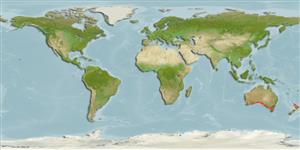
laut; payau dasar (demersal); kisaran kedalaman 1 - 100 m (Ref. 9563). Temperate; 30°S - 43°S
Indo-Pacific: known only from southern Australia.
Panjang pada saat jatuh tempo pertama / Ukuran / Berat / umur
Kematangan: Lm 23.5 range ? - ? cm
Max length : 46.0 cm TL jantan/; (Ref. 9563); Berat maksimum terpublikasi: 3.1 kg (Ref. 6390)
deskripsi pendek
Kunci identifiaksi (pengenalan) | Morfologi | Morfometrik
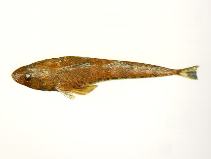
vertebrata, bertulang belakang: 18 - 20. This species differs from Platycephalus westraliae in having the following characters: both second dorsal and anal fin rays usually 14 (vs. 13), total gill rakers 18-20 (vs. 10); palatine with a tooth band comprised of several irregular rows of conical teeth (vs. with an inner larger conical and an outer smaller villiform tooth rows); caudal fin with several small pale brown spots on the upper lobe and one or two large dark brown or black spots on the lower lobe, and with concave posterior margin (vs. with 3 dark bands and with mostly straight posterior margin) (Ref. 86914).
Body shape (shape guide): elongated.
Inhabit coastal waters from shallow bays and inlets to depths of about 100 m over sand, shell grit and mud substrates (Ref. 6390). Sand flathead are usually solitary but may form loose aggregations (Ref. 2165, 27247). They sometimes move long distances (Ref. 6390). They are active foragers and ambush predators (Ref. 6390), occasionally are scavengers (Ref. 6390). Feed on crustaceans and fish (Ref. 2165). Its fin spines are venomous, can inflict mild to severe pain (Ref. 125684).
Paxton, J.R., D.F. Hoese, G.R. Allen and J.E. Hanley, 1989. Pisces. Petromyzontidae to Carangidae. Zoological Catalogue of Australia, Vol. 7. Australian Government Publishing Service, Canberra, 665 p. (Ref. 7300)
Status IUCN Red List (Ref. 130435: Version 2025-2 (Global))
penggunaan manusia
Perikanan: komersial
Alat, peralatan
laporan khas
muat turun XML
Sumber internet
Estimasi berdasarkan model
Suhu yang disukai (Acuan
123201): 14.6 - 18.5, mean 17.1 °C (based on 242 cells).
Indeks keanekaragaman filogenetik (Acuan
82804): PD
50 = 0.5000 [Uniqueness, from 0.5 = low to 2.0 = high].
Bayesian length-weight: a=0.00398 (0.00318 - 0.00498), b=3.13 (3.06 - 3.20), in cm total length, based on LWR estimates for this species (Ref.
93245).
Tingkat Trofik (Acuan
69278): 4.3 ±0.75 se; based on food items.
Daya lenting (Acuan
120179): sedang, Waktu penggandaan populasi minimum 1.4 - 4.4 tahun (K=0.19; tmax=9).
Kerentanan Penangkapan Ikan (Ref.
59153): Low to moderate vulnerability (29 of 100).
🛈
Nutrisi (Ref.
124155): Calcium = 65 [6, 306] mg/100g; Iron = 0.792 [0.214, 2.004] mg/100g; Protein = 18 [16, 20] %; Omega3 = 1.01 [0.44, 2.67] g/100g; Selenium = 18.8 [5.0, 75.1] μg/100g; VitaminA = 25.4 [8.9, 72.5] μg/100g; Zinc = 0.651 [0.297, 1.378] mg/100g (wet weight);