>
Cypriniformes (Carps) >
Leuciscidae (Minnows) > Leuciscinae
Etymology: Chondrostoma: Greek, chondros = cartilage + Greek, stoma = mouth (Ref. 45335). Name referring to the characteristic horny layer on the lower lip (Ref. 57917).
More on author: Linnaeus.
Ambiente: milieu / zona climatica / distribuzione batimetrica / gamma di distribuzione
Ecologia
; acqua dolce benthopelagico; potamodromo (Ref. 51243). Temperate; 56°N - 37°N, 0°E - 35°E
Europe: Basins of Black (Danube, Dniestr, South Bug and Dniepr drainages), southern Baltic (Nieman, Odra, Vistula) and southern North Seas (westward to Meuse). Invasive or introduced in Rhône, Loire, Hérault, Seine (France) and Soca (Italy, Slovenia) drainages. Reports from the Drin drainage including Lakes Ohrid and Skadar represent a distinct species. Asia: Turkey.
Dimensione / Peso / Età
Maturità: Lm ? range ? - ? cm
Max length : 50.0 cm TL maschio/sesso non determinato; (Ref. 556); common length : 25.0 cm TL maschio/sesso non determinato; (Ref. 556); peso massimo pubblicato: 1.5 kg (Ref. 556); Età massima riportata: 15 anni (Ref. 30578)
Breve descrizione
Chiavi di identificazione | Morfologia | Morfometria
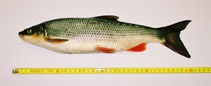
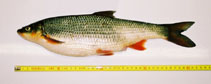
Spine dorsali (totale) : 3; Raggi dorsali molli (totale) : 8 - 10; Spine anali: 3; Raggi anali molli: 9 - 11; Vertebre: 47 - 48. Diagnosed from congeners in Black and Caspian Sea basins by the following characters: straight mouth in individuals larger than 20 cm SL, lower lip with thick cornified sheath; dorsal fin with 9½ branched rays; anal fin with 10-11½ branched rays; scales on lateral line 52-66 (usually 60-63); eye large, diameter 50-65% of interorbital distance; and side lacking broad dark midlateral stripe. Differs from species of Chondrostoma, Protochondrostoma and Parachondrostoma in Atlantic, Adriatic and Mediterranean basins of France, Italy and Slovenia by having the following features: mouth straight, lower lip with thick cornified sheath; 27-36 gill rakers; anal fin with 10-11½ branched rays; and pectoral, pelvic, anal and caudal fins red (Ref. 59043).
(Ref. 59043). Caudal fin with 19 to 21 rays (Ref. 40476).
Body shape (shape guide): fusiform / normal.
Gregarious. Adults occur in fairly shallow water with fast current, often beside the swirls created by piles of bridges or rocks (Ref. 30578). They inhabit moderate to fast-flowing large to medium sized rivers with rock or gravel bottom. Larvae occur below surface and feeding larvae inhabit along shores. Early juveniles live on the bottom in very shallow shoreline habitats. When growing, they move from the shore for faster-flowing waters. Juveniles overwinter in backwaters or in cavities along shores. During winter, adults form dense swarms in lower parts of rivers. Larvae and early juveniles prey on small invertebrates while larger juveniles and adults feed on benthic diatoms and detritus. Adults migrate upstream some tens of km to spawning sites which are often located in tributaries. Spawning occurs in fast flowing water on shallow gravel beds (Ref. 556, 59043). Its flesh is good but bony (Ref. 30578). Locally threatened by damming, destruction of spawning sites and pollution. In drainages where they are introduced, they outcompete and eliminate Parachondrostoma toxostoma in Rhône and Protochondrostoma genei in Soca (Ref. 59043).
Migrates some tens of km to spawning sites, which are often located in tribbutaries. Males form large aggregations, each male defending a small territory. Females spawn only once a year and in some populations, during a very short period of 3-5 days. Females lay sticky eggs into excavations made in gravel (Ref. 59043).
Kottelat, M. and J. Freyhof, 2007. Handbook of European freshwater fishes. Publications Kottelat, Cornol and Freyhof, Berlin. 646 pp. (Ref. 59043)
Stato della Lista Rossa IUCN (Ref. 130435: Version 2025-2 (Global))
Minaccia per l'uomo
Harmless
Usi umani
Pesca: scarso interesse commerciale; Acquario: Acquari pubblici
Strumenti
Rapporti speciali
Scarica XML
Fonti Internet
Stime basate su modelli
Indice di diversità filogenetica (Fonte Biblio.
82804): PD
50 = 0.5000 [Uniqueness, from 0.5 = low to 2.0 = high].
Bayesian length-weight: a=0.00724 (0.00433 - 0.01212), b=3.12 (2.98 - 3.26), in cm total length, based on LWR estimates for this species & (Sub)family-body (Ref.
93245).
Livello trofico (Fonte Biblio.
69278): 2.0 ±0.00 se; based on food items.
Generation time: 4.8 ( na - na) years. Estimated as median ln(3)/K based on 2
growth studies.
Resilienza (Fonte Biblio.
120179): Medio, tempo minimo di raddoppiamento della popolazione 1.4 - 4.4 anni (tm=3-4; tmax=15; Fec=10,000-40,000).
Vulnerabilità della pesca (Ref.
59153): Moderate to high vulnerability (48 of 100).
🛈
Nutrienti (Ref.
124155): Calcium = 52.1 [29.3, 101.5] mg/100g; Iron = 0.863 [0.410, 1.540] mg/100g; Protein = 17.7 [16.1, 19.2] %; Omega3 = 1.1 [0.5, 2.7] g/100g; Selenium = 17.5 [6.6, 42.2] μg/100g; VitaminA = 32.6 [11.5, 91.2] μg/100g; Zinc = 0.593 [0.362, 1.567] mg/100g (wet weight); based on
nutrient studies.