>
Eupercaria/misc (Various families in series Eupercaria) >
Labridae (Wrasses) > Julidinae
Eponymy: Albertus Jacobus Duymaer van Twist (1809–1887) was Governor-General of the Dutch East Indies (1851–1856). He is known to have made a collection of zoological specimens during a journey to the Moluccas (1855). (Ref. 128868), visit book page.
More on author: Bleeker.
Entorno: milieu / zona climática / rango de profundidad / gama de distribución
Ecología
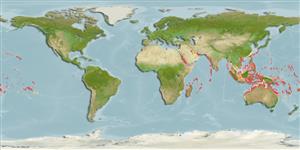
marino asociado a arrecife; rango de profundidad 5 - 30 m (Ref. 9823). Tropical; 30°N - 28°S
Indo-Pacific: Red Sea to the Tuamoto Islands, north to Ryukyu Islands, south to Rapa.
Tamaño / Peso / Edad
Madurez: Lm ? range ? - ? cm
Max length : 18.0 cm TL macho / no sexado; (Ref. 30573)
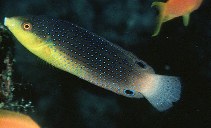
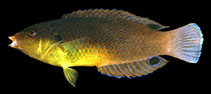
Espinas dorsales (total) : 9; Radios blandos dorsales (total) : 12; Espinas anales: 3; Radios blandos anales: 11 - 13. Body brown, shading to yellow on abdomen, thorax and lower head, and to reddish posteriorly; reddish lips; posterior of operculum with a large black spot, a green spot above and adjacent to this, and above this is a red spot. Pectoral base with a dark brown bar. Dorsal spines pungent.
Body shape (shape guide): fusiform / normal; Cross section: compressed.
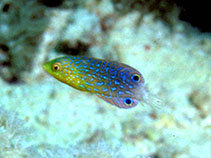
Adults occur in clear lagoon and seaward reefs from the lower surge zone to a depth of 30 m (Ref. 1602). Usually in areas with mixed rubble, coral, or rock and sand (Ref. 9710). Usually solitary among large corals. Small juveniles swim with their head down, keeping dorsal and anal fins erected, and may seem like the face of a larger fish when viewed from side on by a predator (Ref. 48636). Oviparous, distinct pairing during breeding (Ref. 205). Occasionally seen in fish markets and aquarium trade.
Ciclo vital y comportamiento de apareamiento
Madurez | Reproducción | Puesta | Huevos | Fecundidad | Larva
Oviparous, distinct pairing during breeding (Ref. 205).
Westneat, M.W., 2001. Labridae. Wrasses, hogfishes, razorfishes, corises, tuskfishes. p. 3381-3467. In K.E. Carpenter and V. Niem (eds.) FAO species identification guide for fishery purposes. The living marine resources of the Western Central Pacific. Vol. 6. Bony fishes part 4 (Labridae to Latimeriidae), estuarine crocodiles. FAO, Rome. (Ref. 9823)
Situación en la Lista Roja de la UICN (Ref. 130435: Version 2025-2 (Global))
Amenaza para el ser humano
Harmless
Usos humanos
Pesquerías: escaso valor comercial; Acuario: Comercial
Herramientas
Informes especiales
Descargar XML
Fuentes de Internet
Estimaciones basadas en modelos
Temperatura preferida (Referencia
123201): 24.9 - 29.3, mean 28.2 °C (based on 2766 cells).
Índice de diversidad filogenética (Referencia
82804): PD
50 = 0.5002 [Uniqueness, from 0.5 = low to 2.0 = high].
Bayesian length-weight: a=0.00977 (0.00468 - 0.02039), b=3.07 (2.90 - 3.24), in cm total length, based on LWR estimates for this (Sub)family-body shape (Ref.
93245).
Nivel trófico (Referencia
69278): 3.5 ±0.37 se; based on food items.
Resiliencia (Referencia
120179): Alto, población duplicada en un tiempo mínimo inferior a 15 meses (Preliminary K or Fecundity.).
Vulnerabilidad pesquera (Ref.
59153): Low vulnerability (10 of 100).
🛈
Nutrientes (Ref.
124155): Calcium = 76.6 [46.0, 126.8] mg/100g; Iron = 0.683 [0.402, 1.246] mg/100g; Protein = 18.5 [15.6, 20.7] %; Omega3 = 0.153 [0.101, 0.236] g/100g; Selenium = 23.8 [14.6, 42.4] μg/100g; VitaminA = 138 [43, 498] μg/100g; Zinc = 1.61 [1.12, 2.51] mg/100g (wet weight);