>
Gadiformes (Cods) >
Macrouridae (Grenadiers or rattails)
Etymology: Coelorinchus: Greek, koilos = a hollow + Greek, rhyngchos = jaw (Ref. 45335).
Entorno: milieu / zona climática / rango de profundidad / gama de distribución
Ecología
marino batidemersal; rango de profundidad 300 - 800 m (Ref. 26363). Deep-water
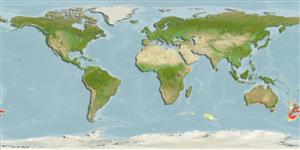
Southwest Pacific: Australia (New South Wales to Victoria and Tasmania) and New Zealand.
Tamaño / Peso / Edad
Madurez: Lm ? range ? - ? cm
Max length : 28.5 cm TL macho / no sexado; (Ref. 26363)
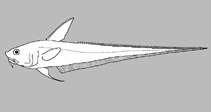
Espinas dorsales (total) : 2. Several faint dark dorsal saddle marks on the posterior half of the body; pale intervening marks about the width of two scale rows; naked ventral surface of head and lower jaw (some with 1-3 scales beside articulation of lower jaw); dorsal anterior snout with naked triangular areas; naked below nostrils to suborbital ridge; large well-developed oval dermal window of light organ separated from anus by 2-3 rows of scales; lateral and medial processes of nasal bone not continuous (Ref. 26363). Resembles Caelorinchus maurofasciatus, C. mystax, C. bollonsi, C. cookianus, and C. fasciatus. Differs from C. mystax, C. bollonsi, and C. fasciatus in numbers of pyloric caeca (22-28 versus 111-115, 27-38, 12-23, respectively) in addition to other characters (Ref. 26363). C. parvifasciatus has similar numbers of pyloric caeca to C. maurofasciatus and C. cookianus but differs in having saddle markings only on the posterior half of the body (Ref. 26363).
Body shape (shape guide): elongated.
A benthic species found on the continental slope (Ref. 75154).
Ciclo vital y comportamiento de apareamiento
Madurez | Reproducción | Puesta | Huevos | Fecundidad | Larva
McMillan, P.J. and C.D. Paulin, 1993. Description of nine new species of rattails of the genus Caelorinchus (Pisces, Macrouridae) from New Zealand. Copeia 1993(3):819-840. (Ref. 26363)
Situación en la Lista Roja de la UICN (Ref. 130435: Version 2025-2 (Global))
Amenaza para el ser humano
Harmless
Usos humanos
Herramientas
Informes especiales
Descargar XML
Fuentes de Internet
Estimaciones basadas en modelos
Temperatura preferida (Referencia
123201): 6.7 - 11.2, mean 8.5 °C (based on 140 cells).
Índice de diversidad filogenética (Referencia
82804): PD
50 = 0.5000 [Uniqueness, from 0.5 = low to 2.0 = high].
Bayesian length-weight: a=0.00257 (0.00132 - 0.00501), b=3.19 (3.02 - 3.36), in cm total length, based on LWR estimates for this Genus-body shape (Ref.
93245).
Nivel trófico (Referencia
69278): 3.5 ±0.5 se; based on size and trophs of closest relatives
Resiliencia (Referencia
120179): Medio, población duplicada en un tiempo mínimo de 1.4-4.4 años (Preliminary K or Fecundity.).
Vulnerabilidad pesquera (Ref.
59153): Low vulnerability (19 of 100).
🛈