>
Holocentriformes (Squirrelfishes, soldierfishes) >
Holocentridae (Squirrelfishes, soldierfishes) > Holocentrinae
Etymology: Sargocentron: Greek, sargos = sargus + Greek, kentron = sting (Ref. 45335).
More on author: Rüppell.
Entorno: milieu / zona climática / rango de profundidad / gama de distribución
Ecología
marino asociado a arrecife; rango de profundidad 2 - 40 m (Ref. 27370). Tropical; 32°N - 24°S
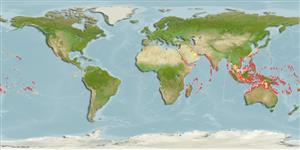
Indo-Pacific: Red Sea and East Africa (south to the latitude of the Xora River, South Africa) to the Marshall Islands and French Polynesia, north to Japan, south to Australia.
Tamaño / Peso / Edad
Madurez: Lm ? range ? - ? cm
Max length : 25.0 cm TL macho / no sexado; (Ref. 4201); common length : 18.0 cm TL macho / no sexado; (Ref. 3418)
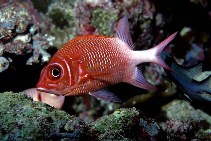
Espinas dorsales (total) : 11; Radios blandos dorsales (total) : 13 - 15; Espinas anales: 4; Radios blandos anales: 8 - 9. Head and body red, edges of scales silver; silvery white spot anterodorsally on caudal peduncle (often disappears after death); spinous part of dorsal fin mottled light red, the outer part of the membranes bright red (Ref. 4201). 4-5 oblique rows of scales on cheek. Body depth 2.3-2.7 in SL; head length 2.3-2.8 in SL; snout length 3.6-4.0 in head length. Maxilla extending posteriorly from front of pupil to the center of eye; upper jaw length 2.7-2.95 in head length; premaxillary groove reaching about front edge of orbit; anterior end of nasal bone with 2 short diverging spines; spine at edge of premaxillary groove absent; anterior edge of nasal fossa with 1 (rarely 2) spinule; upper edge of first suborbital bone not serrated (Ref. 27370).
Body shape (shape guide): fusiform / normal; Cross section: compressed.
One of the most common of the squirrelfishes that occurs in outer reef areas, also encountered in lagoons and drop-offs from less than 2 to 40 m; either solitary or in groups (Ref. 27370). Nocturnal, feeds mainly on benthic crabs and shrimps.
Ciclo vital y comportamiento de apareamiento
Madurez | Reproducción | Puesta | Huevos | Fecundidad | Larva
Randall, J.E., 1998. Revision of the Indo-Pacific squirrelfishes (Beryciformes: Holocentridae: Holocentrinae) of the genus Sargocentron, with descriptions of four new species. Indo-Pac. Fish. (27):105 p. (Ref. 27370)
Situación en la Lista Roja de la UICN (Ref. 130435: Version 2025-2 (Global))
Amenaza para el ser humano
Usos humanos
Pesquerías: escaso valor comercial; Acuario: Comercial
Herramientas
Informes especiales
Descargar XML
Fuentes de Internet
Estimaciones basadas en modelos
Temperatura preferida (Referencia
123201): 25 - 29, mean 27.9 °C (based on 820 cells).
Índice de diversidad filogenética (Referencia
82804): PD
50 = 0.5000 [Uniqueness, from 0.5 = low to 2.0 = high].
Bayesian length-weight: a=0.02239 (0.01332 - 0.03762), b=3.00 (2.86 - 3.14), in cm total length, based on LWR estimates for this species & Genus-body shape (Ref.
93245).
Nivel trófico (Referencia
69278): 3.9 ±0.67 se; based on food items.
Resiliencia (Referencia
120179): Alto, población duplicada en un tiempo mínimo inferior a 15 meses (Preliminary K or Fecundity.).
Vulnerabilidad pesquera (Ref.
59153): Low vulnerability (15 of 100).
🛈
Nutrientes (Ref.
124155): Calcium = 54.9 [21.4, 211.6] mg/100g; Iron = 0.507 [0.199, 1.513] mg/100g; Protein = 18.8 [17.6, 19.9] %; Omega3 = 0.152 [0.067, 0.345] g/100g; Selenium = 31.4 [18.5, 60.8] μg/100g; VitaminA = 78.4 [30.1, 217.6] μg/100g; Zinc = 1.7 [0.7, 3.2] mg/100g (wet weight);