Klassifizierung / Names
Namen | Synonyme | Catalog of Fishes(Gattung, Arten) | ITIS | CoL | WoRMS | Cloffa
Elasmobranchii (Haie und Rochen) (sharks and rays) >
Carcharhiniformes (Ground sharks) >
Scyliorhinidae (Cat sharks) > Scyliorhininae
Etymology: Cephaloscyllium: cephalus, from kephale (Gr.), head, referring to its very broad and depressed head; skylion, Greek for dogfish or small shark (See ETYFish); umbratile: Latin for shaded, described as “marbled above with shades of dark and deep brown” (See ETYFish).
More on authors: Jordan & Fowler.
Umwelt: Milieu / Klimazone / Tiefenbereich / Verbreitungsgebiet
Ökologie
seewasser riff-verbunden; tiefenbereich 20 - 500 m (Ref. 94801). Subtropical
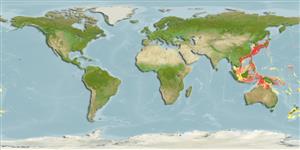
Western North Pacific: Japan Sea, East China Sea (Japan, Korea, China and Taiwan) (Ref. 94801); possibly up to New Zealand. Similar to Cephaloscyllium isabellum but the color pattern is different.
Länge bei der ersten Reifung / Größe / Gewicht / Alter
Geschlechtsreife: Lm 97.9, range 92 - 104 cm
Max length : 120 cm TL Männchen/unbestimmt; (Ref. 95495); 110.0 cm (female)
Kurzbeschreibung
Bestimmungsschlüssel | Morphologie | Morphometrie
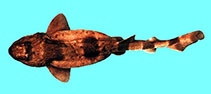
This species is distinguished by the following characters: with three broad dark saddle blotches before first dorsal fin, the first saddle on posterior half of interorbital region and immediately behind eye, second saddle over pectoral fin base, and third saddle at middle between pectoral
and pelvic fin bases; adults with dark and irregular spots, sometimes with white spots between the saddles (Ref. 94801).
Body shape (shape guide): elongated; Cross section: angular.
Found on rocky reefs (Ref. 12951); near shore, down to 300 m on sandy mud bottoms (Ref. 11230). Feeds mainly on bony fishes such as mackerel, sardines, filefishes, moray eels, dragonets, flatfishes and cowfishes (Ref. 12951) but also preys on elasmobranches and squid (Ref. 12951). Oviparous (Ref. 50449). Thrives and breeds in public aquariums (Ref. 12951).
Lebenszyklus und Paarungsverhalten
Geschlechtsreife | Fortpflanzung | Ablaichen | Eier | Fruchtbarkeit | Larven
Oviparous (Ref. 559), two tendril eggcases are deposited at one time (Ref. 12951). Embryos feed solely on yolk (Ref. 50449). Eggs hatch after about 1 year and size upon hatching is 16-22 cm (Ref. 12951).
Nakaya, K., S. Inque and H.-C. Ho, 2013. A review of the genus Cephaloscyllium (Chondrichthyes: Carcharhiniformes: Scyliorhinidae) from Taiwanese waters. Zootaxa 3752(1):101-129. (Ref. 94801)
IUCN Rote Liste Status (Ref. 130435: Version 2025-2 (Global))
Nutzung durch Menschen
Fischereien: kommerziell; Aquarium: Öffentliche Aquarien
Tools
Zusatzinformationen
Download XML
Internet Quellen
Schätzungen auf der Grundlage von Modellen
Bevorzugte Temperatur (Ref.
123201): 11.5 - 26.5, mean 19.2 °C (based on 435 cells).
Phylogenetischer Diversitätsindex (Ref.
82804): PD
50 = 0.5000 [Uniqueness, from 0.5 = low to 2.0 = high].
Bayesian length-weight: a=0.00269 (0.00140 - 0.00518), b=3.21 (3.04 - 3.38), in cm total length, based on LWR estimates for this (Sub)family-body shape (Ref.
93245).
Trophische Ebene (Ref.
69278): 4.5 ±0.76 se; based on food items.
Widerstandsfähigkeit (Ref.
120179): niedrig, Verdopplung der Population dauert 4,5 - 14 Jahre. (Fec assumed to be <100).
Anfälligkeit der Fischerei (Ref.
59153): Moderate to high vulnerability (49 of 100).
🛈